

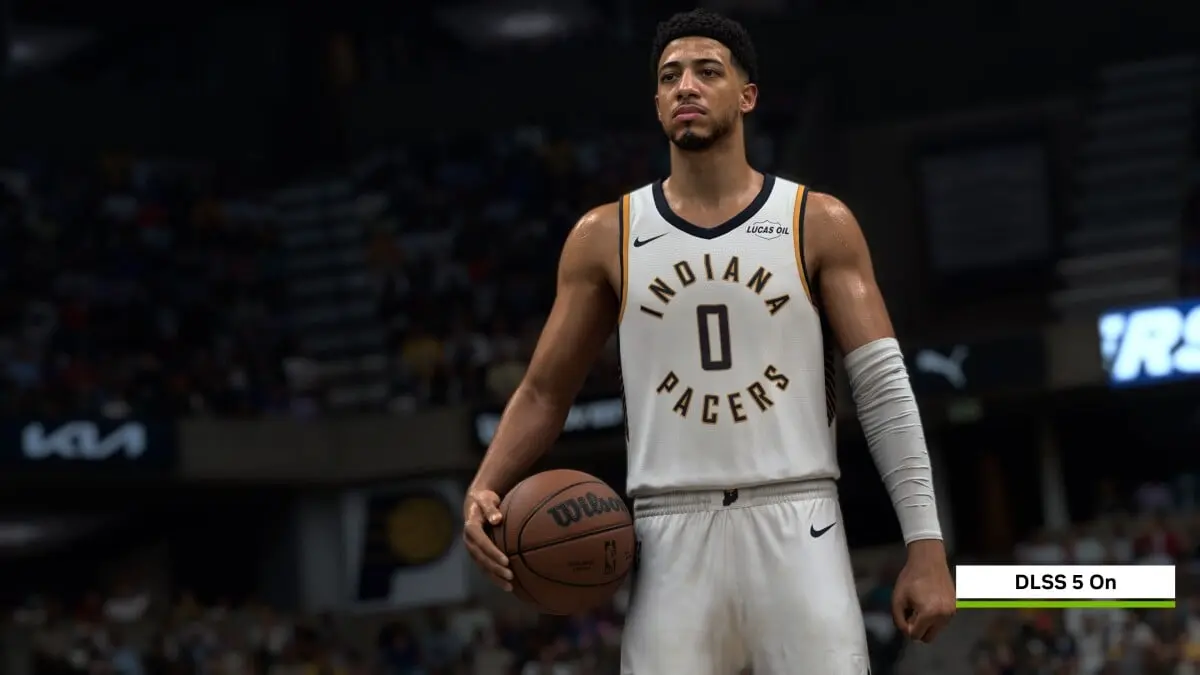
If you've spent any time on gaming social media this week, you've probably seen a lot of comparison screenshots. The most common ones are split-screen images pairing an older screenshot with a more detailed version. The caption often claims that the new version represents the future of gaming.
That future is DLSS 5, NVIDIA's latest and most ambitious version of its AI upscaling technology. It officially launches Sept. 3 and is exclusive to the company's RTX 50-series graphics cards. It arrives alongside only one game: NBA 2K27.
What is DLSS 5?
For years, DLSS has existed as a clever performance booster. Render a game at a lower resolution and then let an AI model reconstruct missing detail to reach a higher resolution output. That approach allows graphics cards to produce smoother frame rates without requiring every single pixel to be natively rendered.
The new version goes much further. DLSS 5 is designed to add more realistic lighting and materials to a scene in real time. It can actively repaint lighting, textures, and character faces while gameplay is running. When NVIDIA first unveiled the technology in March, the company described it as a landmark moment and its biggest graphics breakthrough since real-time ray tracing debuted in 2018.
NVIDIA says the system also returns creative control to developers. They get sliders to dial in exactly how aggressive the AI's changes are, perhaps leaving character faces untouched or limiting enhancements to background details. That suggests a flexible tool, but the first public demos already revealed how controversial that flexibility can be.
Why DLSS 5 is controversial
Backlash has existed since the tech demo for Resident Evil: Requiem. In that demo, the protagonist Grace Ashcroft was shown with and without DLSS 5. The AI-enhanced version looked different enough from the original to spark a whole meme cycle online. Critics called the change the yassification of the character because the AI gave her face a softer, glossier look that many considered inappropriate or unnecessary.
DLSS 5 believers see legitimate leaps in performance and visual fidelity, particularly in sports and photorealistic titles where the tech seems to deliver on its promises. They argue that the bad examples online come from people who pushed the AI sliders to absurd levels in order to show the technology at its worst. In that version of the conversation, DLSS 5 is a nuanced tool that looks as good as the person using it.
Critics respond by pointing out that letting an AI model reinterpret a character's face or a room's lighting overrides decisions made by actual artists. The AI is making aesthetic choices that the artists may never have approved. For many gamers, no one asked the AI to redesign the art direction. In some examples, the results genuinely look bad: warped textures, unnatural smoothness, and faces that no longer resemble their original scans.
The debate is not only about whether the images look good, but also about who has the final creative say on what the player sees. Video game art direction is built on countless deliberate decisions by character modelers, lighting designers, and environment artists. When an AI quietly changes those decisions after the artists have finished their work, authorship starts to feel very murky. Even if the AI is only adding detail, players who value hand-crafted game worlds are understandably uncomfortable seeing an algorithm take over the presentation.
Social media has been filled with side-by-side posts showing the same game with and without DLSS 5. Some show heroines turned into glossy influencers. Others show familiar landmarks stripped of their original mood. In one tweet after another, the same pattern appears: the default version looks moody and intentional, while the DLSS 5 version looks cleaner but also less personal.
Performance costs and frame generation
All of this visual alteration has a real performance price. NVIDIA itself estimates that DLSS 5 costs 50 to 60 percent of your performance, offset by aggressive frame generation. The company claims that even a mid-range RTX 5060 can run NBA 2K27 at 1080p with ray tracing and DLSS 5 maxed out, but only if the system also has a top-tier CPU and 6x frame generation enabled.
That detail matters. With 6x frame generation, the GPU is inventing five out of every six frames you see rather than rendering them directly. The visual result may be smooth, but it relies on extrapolation and guesswork. Some players are comfortable with that because the final experience can be remarkably fluid. For others, it weakens the idea that DLSS 5 is delivering true native-quality graphics.
Hardware pricing realities
The conversation is also happening in a consumer PC market that remains incredibly difficult to navigate. NVIDIA's original DLSS 5 demonstrations leaned heavily on the RTX 5090. That card has a suggested retail price of $2,000, but because of the ongoing memory crisis squeezing the PC market, it has been reselling for two to three times that on secondary markets. The company's own demonstration setup reportedly used two of those cards. That puts the ideal version of DLSS 5 far outside most people's budgets.
Even the lower-end RTX 5060 is feeling the pressure. Some of the cheaper versions of that card are still priced above $400, which is a far cry from the old idea of an accessible mid-range GPU. NVIDIA's pitch is that DLSS 5 makes ray-traced, high-frame-rate gaming reachable on mid-range cards, but the mid-range itself has become much less affordable. As a result, the fully loaded version of this future-of-graphics pitch is, for now, mostly a luxury good.
Can DLSS 5 be used responsibly?
Some of the controversy might be softened if developers prove they can use the granular controls responsibly. NVIDIA says developers can choose to keep character faces untouched or limit the AI's work to specific scene elements. If that works as advertised, DLSS 5 may function as an optional enhancement rather than a forced replacement of the existing art style. But that depends on how individual studios define the word improvement.
The bigger question is whether NVIDIA can convince more developers to adopt DLSS 5. A single launch title, NBA 2K27, is not enough to make it a PC gaming standard. Sports games and photorealistic simulators may benefit the most from a technology that enhances surfaces, lighting, and environmental detail. But highly stylized games may not benefit as much if the AI distorts the art style players have come to love.
The only clear way to experience DLSS 5 for now is to boot up NBA 2K27 on Sept. 3 and toggle the setting yourself. Or you can watch the strange images being generated on social media right now, many of which have already turned into memes. How players react to those images may help determine whether game developers feel safe adding DLSS 5 to their own projects, and whether the technology becomes a standard part of PC gaming or remains a niche feature for realism-focused titles.
Source:Mashable News