

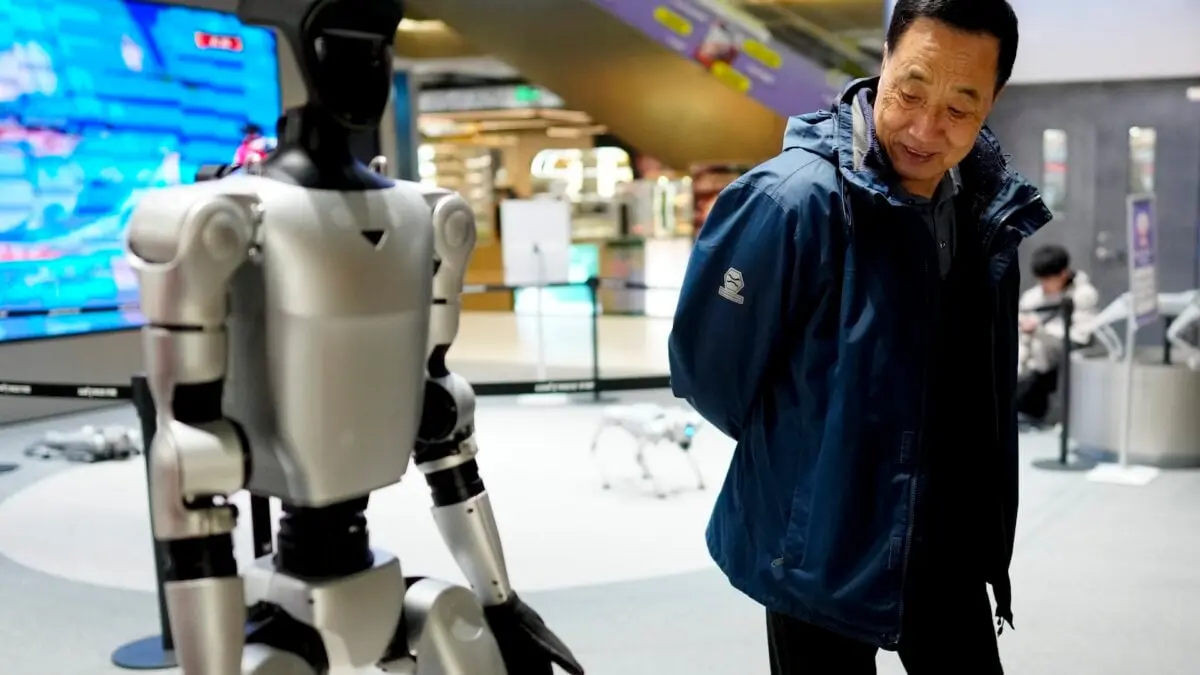
The U.S. Federal Communications Commission on Tuesday announced a sweeping ban on advanced foreign-made robots, a move widely interpreted as a direct attempt to slow the rapid expansion of China’s robotics and artificial intelligence industries. The new restrictions cover mobile two-legged humanoid robots and four-legged quadrupeds, categories that include some of the most visible machines in the global robotics market. In a statement, the FCC said the devices “pose unacceptable risks to the national security of the United States or the safety and security of United States persons.”
What the ban covers
The ban applies to equipment authorization, the process by which electronic devices are approved for sale in the United States. Foreign-made humanoid robots and quadruped robots will no longer receive that authorization unless they fall under a specific exception. The FCC also included power inverters created by foreign companies in the new restrictions, although regulators have already granted exemptions for some of those devices. The agency pointed to a government study indicating that national security agencies had determined these robots could create supply chain vulnerabilities and potentially introduce cybersecurity risks.
Why robots are a security concern
The security rationale echoes warnings that have been used about other Chinese technology. A humanoid or quadruped robot is equipped with sensors, cameras, microphones, and an AI brain that can process its surroundings. Foreign governments could theoretically use those capabilities to collect information about hospitals, offices, factories, or military zones. The FCC argued that relying on foreign-made robots in American homes and critical infrastructure creates unacceptable national security hazards. The same kind of concern was raised about TikTok before the social media platform was forced to sell a majority stake to U.S. interests. President Donald Trump, who initially backed the TikTok ban, changed his position after wealthy U.S. and Middle East investors expressed interest in buying the platform.
China’s robotics boom
China is now a dominant force in humanoid robotics. Companies such as Unitree Robotics have built robot dogs and bipedal humanoids that are agile, relatively affordable, and widely distributed. Unitree already sells its machines inside the United States, and their appearances in viral videos have made them familiar to American consumers. The new ban is widely seen as an attempt to keep the next generation of those robots out of the U.S. market. Elon Musk’s Tesla Optimus, which has not yet been released, would therefore face less competition from Chinese humanoid robots in the United States.
A new front in U.S.-China decoupling
The FCC action must be understood as part of a broader decoupling between Washington and Beijing. Since the late 2010s, the United States has imposed export controls on Chinese telecom firms, semiconductor companies, and AI-related technologies. Now physical robots are being added to that list. China’s government has made humanoid robotics a strategic priority, with manufacturing roadmaps and state-backed investment. U.S. defense officials have also warned that advanced robots could be used in future conflicts for logistics, reconnaissance, or urban combat. That dual-use potential helps explain why national security agencies were involved in the FCC review. The decision also aligns with existing restrictions on Chinese drone makers. It is not just about consumer gadgets; it is about military and industrial potential.
Exemptions and exceptions
The ban does not apply to robots that have already been purchased. Consumers and companies that already own foreign-made humanoid robots or robotic dogs will not be required to destroy or return them. Retailers may continue selling models that were previously approved through the FCC’s authorization process. The U.S. government is also allowed to purchase whatever overseas robots it wants, according to the release. That exemption has invited criticism: if the robots are truly a national security risk, why should the American military or intelligence community be allowed to buy them? The FCC said exporters may apply for conditional approval, and the Department of Defense and Department of Homeland Security have already granted exemptions for some power inverters. In a quirky detail, the FCC’s release referred to the Department of Defense by its historical name, the Department of War.
Political reaction
FCC Chairman Brendan Carr praised the ban and credited President Trump with providing leadership on the issue. Carr said the FCC would continue to secure America’s critical supply chains and act in lock step with national security agencies. Like many federal officials in the Trump administration, he made a point of deferring to the president in his public statement. The move is likely to intensify the broader debate over U.S.-China technology policy. Some lawmakers want even more restrictions on Chinese-made hardware and software; others warn that broad bans could raise prices, reduce choice, and push American companies into overreliance on domestic suppliers that are not yet ready to fill the gap.
Broader market consequences
The ban may also force foreign robotics companies to rethink their U.S. strategies. Some might seek conditional approvals for specific products; others could consider setting up factories in the United States or other allied countries. But that will not be quick or cheap. Chinese firms have developed a massive manufacturing ecosystem around robotics, with low-cost motors, sensors, actuators, and batteries. Many American robot makers still depend on those Chinese-made components, even if their final products are assembled domestically. The FCC order targets finished foreign robots, but it does not fully address the deeper supply-chain relationship. That complexity suggests the ban is only the opening move in a much longer policy struggle.
What happens next
The immediate impact on consumers is muted. Popular robots already on the market can continue to be sold through existing retail channels, but new models from Chinese manufacturers will likely struggle to gain FCC approval. Companies such as Unitree may try to obtain conditional exemptions or relocate some production to the United States. In the long run, the ban marks a turning point: physical robots are now a frontline in the competition for technological supremacy. U.S. regulators are treating them the way they once treated 5G equipment and advanced semiconductors. For American buyers who were hoping to get their hands on the next Unitree machine, the message is unmistakable. As one observer put it, Americans won’t be able to buy the Unitree Gundam anytime soon.
Source:Gizmodo News