

If you're worried about the impact of AI on the IT profession and thinking about which direction to take your career, the smartest answer is to focus on honing the skills that will help you become the latest, and perhaps greatest, enterprise AI expert of all: the frontier engineer.
What is a frontier engineer?
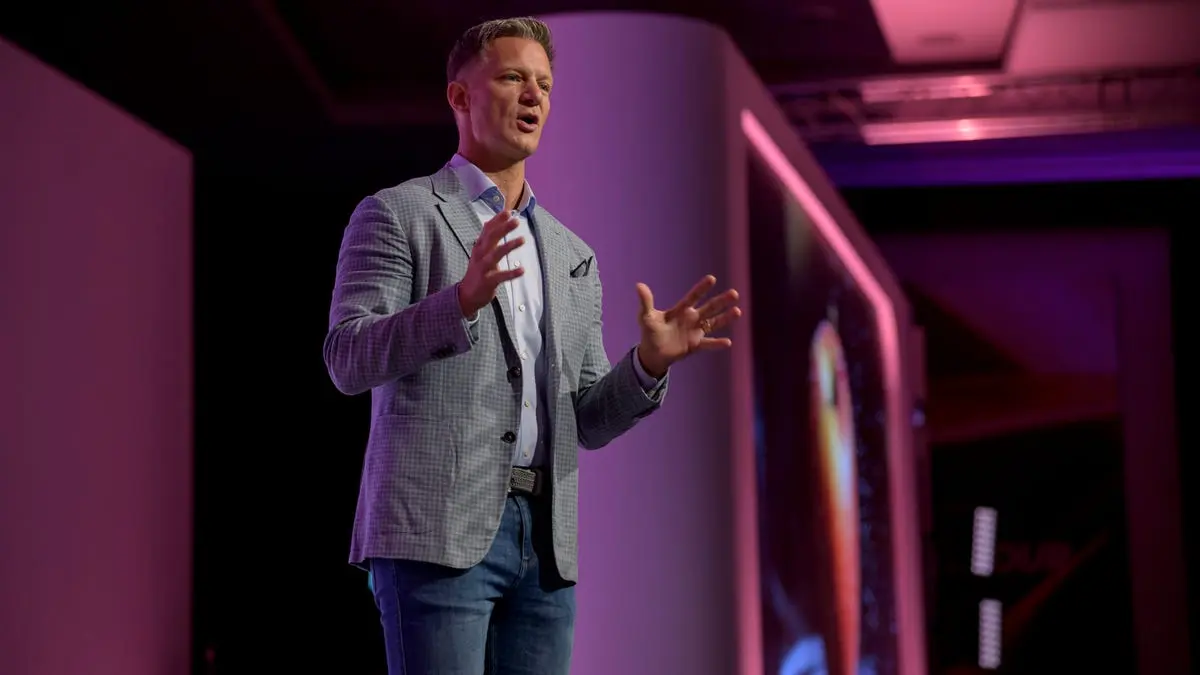
Steve Lucas, CEO of integration technology specialist Boomi, outlined how the frontier engineer -- someone with an advanced degree in data and neural networking -- will become the key professional who unlocks competitive advantage in the age of AI. Lucas shared his insights during a one-to-one chat at his firm's World Tour event in London, UK.
"Organizations will succeed when they have a deep understanding of how to optimize frontier models, how to use them, and someone has to think about those issues every day -- and a CIO needs that person, whoever she or he is, to be part of the organization," he said.
Lucas knows more about the likely trajectory of the technology industry than most. CEO of Boomi since December 2022 and formerly CEO of iCIMS and Marketo, as well as a holder of senior executive positions at Salesforce and SAP, he is now helping the integration specialist and its customers to navigate effective data use in an era of agents.
It's within this complex environment that Lucas said frontier engineers will bring clarity. However, IT professionals should be warned -- this high-profile role requires specialist qualifications and involves challenging responsibilities. For this reason, frontier engineers will be in massive demand as companies seek to stay ahead of their rivals.
"You don't need 100 of those people, but here's a question to ask every single CEO out there: 'Is there one human in your company, one, that understands how neural networks work?'" asked Lucas. "I would endeavor to say that for 95% of organizations, the answer would be unequivocally no -- and yet this is the fire that we are playing with."
Cutting through the hype
Lucas set the rise of the frontier engineer in context. In many ways, the role is the latest in a long line of hyped-up AI-focused positions. However, the twist this time is that the frontier engineer will be a crucial position in the longer term, not just a short-term flash in the recruitment pan.
Lucas turned first to prompt engineers, saying the role was once the flavor of the month for job seekers and the firms that wanted to employ talent: "Professionals got told all the time, article after article, video after video, that 'Here's the best way to extract the answer out of a model,' and for a year-plus, the focus was prompt engineering."
Then OpenClaw was released in late 2025, and the IT recruitment trend changed again: "All of a sudden, it was, 'Well, now we need harnesses,'" said Lucas, referring to the operational software layer that helps AI models act reliably. This demand led to the rise of other roles: "Then there was talk of harness engineer jobs, and more hyper-accelerated cycles."
More recently, loop engineering -- the practice of designing, operating, and improving the feedback loops that let AI coding agents plan work -- has become a must-have skill. Once again, Lucas said the recruitment influencers have gone into overdrive. "The growth-hacking crowd says, 'Let's do loops,'" he said. "And now, visit indeed.com, type in 'loop engineer,' and there are jobs that pop up."
Shaking his head at this long line of short-lived roles, Lucas gave a particle physics-based description of the IT recruitment hype cycle: "It's like quarks and bosons that pop into existence and then disappear." More worryingly for the IT professionals following these cycles, the impact could be a shortcut to a career dead end. "Those are not enduring skills," he said. "Enduring skills are understanding data science and neural networking deeply."
Putting knowledge into practice
It's here -- at the sharp end of enterprise AI deployment in data-led terms -- that the frontier engineer role will make a different mark. Lucas traced the origins of the role to the demand for frontier model engineers at Big Tech firms that are pioneering AI innovations. "These engineers are incredibly important," he said, stressing how these talented individuals are also rare.
"I would bet that there are fewer than 3,000 people in the entire world, maybe even fewer than 2,000, who know how to build and train a model at the scale we're seeing today, where they understand neural networks, and they can build a backpropagation-oriented large language model."
As Lucas stressed, that's just 2,000 people globally -- in North America, Europe, Asia, and everywhere else -- who understand how neural nets generate answers to questions. However, even more crucially, he suggested that a tipping point is being reached where more end-user organizations -- not just technology behemoths -- will need an incredibly strong engineer who can put his or her knowledge of the inner workings of frontier models into practice.
"Enterprises will need someone who really understands how neural nets work," he said. "Not necessarily how to build them, that's rare, but how these things work, and how to best optimize them."
When asked what skills this frontier engineer would possess, Lucas said -- at a minimum -- an advanced degree in data and neural networking. He recognized that having strong capabilities across those two specialist domains is uncommon, especially when it comes to using this awareness in a non-technology business. "It's one thing to understand data; it's also another thing to understand neural networks, which is an even rarer skill set," he said. "But the application of that capability in the enterprise is profoundly important."
Squeezing every drop of productivity
Lucas said the frontier engineer's responsibilities differ greatly from other senior positions, such as chief AI officer. "A chief AI officer to me is someone who is thinking about models, frameworks, compliance, integration with the broader organization -- all those things that need to happen," he said. To explain the requirements for the frontier engineer role, Lucas discussed the position of forward-deployed engineers, IT professionals who work closely with customers to ensure that technical solutions are deployed effectively in their operational environments.
"I think all of us have heard that term now, championed by companies like Palantir," he said. "A forward-deployed engineer is, once again, functionally different; that's someone who can iterate, build, and apply a solution to a business problem." Lucas suggested that somewhere in between the AI executive and the AI builder sits the frontier engineer -- someone who knows enough about the finer details of the technology to exploit models effectively.
But be warned: these people are hard to find, said Lucas. "Even inside our own organizations, I know this to be true," he said. "At Boomi, it's difficult to pin down the one person who is a deep expert on neural nets, and can she or he help me squeeze every drop of productivity out of those things?" However, Lucas said finding -- or, for up-and-coming technology professionals, becoming -- that rare individual is likely to be crucial and a pathway to long-term success: "In the end, that capability will mean the difference between winning and losing."
The frontier engineer role is not just about technical prowess; it is about bridging the gap between cutting-edge AI research and practical business applications. As enterprises increasingly rely on AI agents for complex tasks, the ability to fine-tune and optimize these models becomes a competitive necessity. Unlike previous hyped roles, the frontier engineer requires a deep, foundational understanding of neural networks and data science, skills that are not easily acquired through short-term courses. This makes the role both rare and invaluable.
For IT professionals looking to future-proof their careers, investing in advanced education in data and neural networking is a strategic move. The demand for such expertise is only set to grow as more organizations realize that the success of their AI initiatives hinges on having someone who truly understands the technology behind the models. The frontier engineer is not a passing trend but a permanent fixture in the enterprise landscape, ensuring that every drop of potential from AI is squeezed out for maximum productivity and innovation.
Source:ZDNET News