

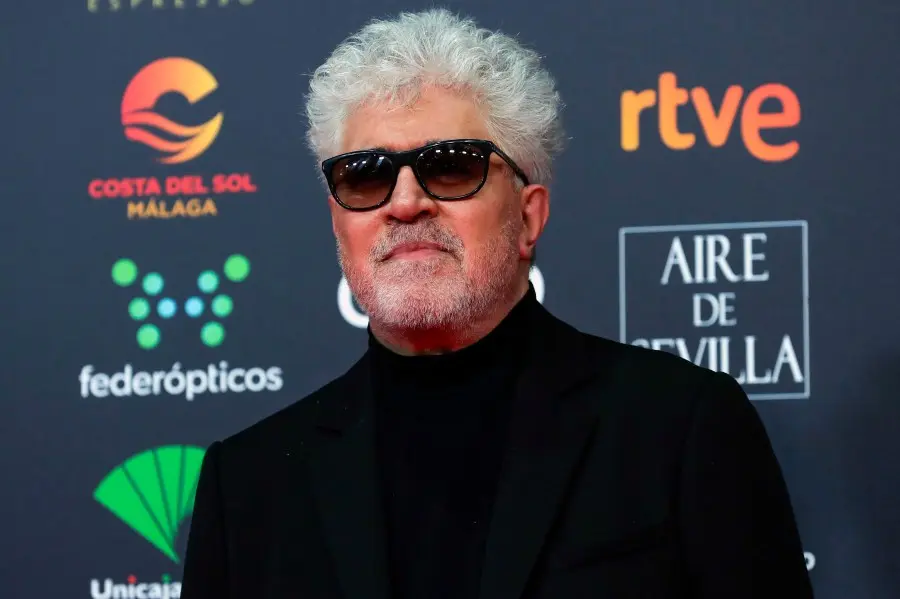
Acclaimed Spanish director Pedro Almodóvar delivered a fiery political speech Monday night while accepting the Film at Lincoln Center’s Chaplin Award in New York City, calling President Donald Trump a “narcissistic authoritarian lunatic” who will “go down in history as a catastrophe.” He dedicated his award to the “thousands deported in recent weeks,” to transgender actress Hunter Schafer, and to Harvard University for its defiance of White House demands.
Almodóvar, 75, the Oscar-winning filmmaker behind “Talk to Her,” “All About My Mother,” and “Pain and Glory,” began his remarks by expressing gratitude but quickly pivoted to doubt about whether he should have attended. “I wish to express my gratitude for this award; however, I admit there have been moments where I have doubted about coming to accept it, in the same way that I would go to… Russia or North Korea,” he said to a packed audience at Lincoln Center.
He continued: “I doubted if it was appropriate to come to a country ruled by a narcissistic, authoritarian lunatic who doesn’t respect human rights and who it seems nothing can stop in his race to change the fragile world balance.” The remarks drew applause from many in attendance.
Almodóvar’s comments come amid a broader wave of criticism from international artists and intellectuals regarding the Trump administration’s policies on immigration, transgender rights, and international relations. The director specifically targeted Trump’s executive orders on immigration, which have led to mass deportations. “Immigrants are not criminals,” he exclaimed. “Trump and his friends — millionaires and oligarchs — cannot convince us that the reality we are seeing with our own eyes is the opposite of what we are living, however much he may twist the words, claiming that they mean the opposite of what they do.”
The Trump administration has touted its deportation efforts, which are being challenged in multiple federal courts. Since returning to office in January 2025, Trump has signed a series of executive orders tightening border security and expanding the definition of who can be deported, leading to the removal of thousands of individuals, including some with long-term U.S. residency and no criminal records.
Almodóvar also weighed in on foreign policy, specifically defending Ukrainian President Volodymyr Zelensky against Trump’s recent accusations. Trump had claimed that Zelensky was a “dictator without elections” and that Ukraine bore responsibility for starting the war with Russia. Almodóvar pushed back sharply: “Zelensky is not a dictator. [Russian President Vladimir Putin] is. And however much Trump denies it, it was Russia that invaded Ukraine.” This echoes the broader European and NATO stance that Russia violated international law by launching a full-scale invasion in February 2022.
The director also addressed Trump’s policies on transgender rights. He referenced the case of Hunter Schafer, the transgender actress from HBO’s “Euphoria,” who revealed in February 2025 that her new U.S. passport bore a male gender marker despite living as a woman for years. This change was attributed to the Trump administration’s strict interpretation of gender under an executive order recognizing only two sexes. “That cruel whim by trans bureaucrats, that there are only two genders, does not change the nature of the human being and its sexual diversity,” Almodóvar said.
Almodóvar’s filmography has long explored themes of identity, sexuality, and political dissent. Born in 1949 in Calzada de Calatrava, Spain, he became a leading figure of the post-Franco countercultural movement known as La Movida Madrileña. His films often feature complex female characters, transgender individuals, and critiques of authoritarianism. He won the Academy Award for Best Foreign Language Film for “All About My Mother” (1999) and the Palme d’Or at Cannes for “Talk to Her” (2002). His most recent film, “The Room Next Door” (2024), starring Julianne Moore and Tilda Swinton, won the Golden Lion at Venice.
His strong political voice is not new. In 2018, he criticized the Spanish government’s handling of the Catalan independence movement, and in 2020 he accused the Trump administration of mishandling the COVID-19 pandemic. Monday’s speech, however, was one of his most direct attacks on a sitting U.S. president.
“Mr. Trump: I’m talking to you. And I hope that you hear what I’m going to say to you,” Almodóvar said, fixing his gaze toward the camera. “You will go down in history as the greatest mistake of our time. Your naiveté is only comparable to your violence. You will go down in history as one of the greatest dangers to humanity in this beginning of the century. You will go down in history as a catastrophe.”
The Chaplin Award, named after silent film legend Charlie Chaplin, is given annually by Film at Lincoln Center to honor individuals who have made a lasting contribution to cinema. Past recipients include Alfred Hitchcock, Martin Scorsese, Meryl Streep, and Catherine Deneuve. Almodóvar is the first Spanish filmmaker to receive the honor.
In dedicating his award, Almodóvar recognized three entities: the “thousands deported in recent weeks” as a result of Trump’s immigration policies; Hunter Schafer, whom he called “beautiful” and whose struggle for recognition of her identity he saw as emblematic of the administration’s cruelty; and Harvard University, which recently rejected a series of policy change demands from the White House. In early April 2025, Harvard refused to comply with Trump administration demands to overhaul its diversity, equity, and inclusion initiatives and to limit certain academic programs. The administration then froze billions of dollars in federal grants, prompting Harvard to file a lawsuit. Almodóvar praised Harvard’s “determination to not surrender to Trump’s war on knowledge and culture which remain the best weapons to fight lies and misinformation.”
The speech was met with both applause and criticism online. Supporters hailed Almodóvar as a courageous artist speaking truth to power, while detractors accused him of disrespecting the country that was honoring him. The White House did not immediately respond to requests for comment.
Almodóvar’s remarks reflect a growing trend among European cultural figures who view Trump’s second term as a fundamental threat to democratic norms and human rights. In recent weeks, other prominent artists have spoken out, including Irish singer Bono, who called Trump’s immigration policy “cruel and stupid,” and British author Salman Rushdie, who criticized the administration’s attacks on the press.
Immigration remains a flashpoint issue. According to government data, over 150,000 people have been detained for deportation since Trump took office in January 2025, with many being sent to countries they had fled from. Courts have blocked some of the most aggressive measures, such as the use of a 1798 law to summarily deport individuals without hearings. Nonetheless, the administration continues to push forward with what it calls “the largest deportation operation in American history.”
Almodóvar’s defense of transgender rights also aligns with broader backlash against the Trump administration’s “Only Two Genders” executive order, which has affected passports, federal documents, and military service. Multiple lawsuits have been filed by civil rights organizations. The case of Hunter Schafer, a highly visible figure, brought the issue into public consciousness.
The director ended his speech without a formal conclusion, letting his words hang in the air. He returned to his seat to a standing ovation from many attendees. For Almodóvar, the message was clear: art and politics are inseparable, and silence in the face of injustice is not an option.
Source:Yahoo News News