

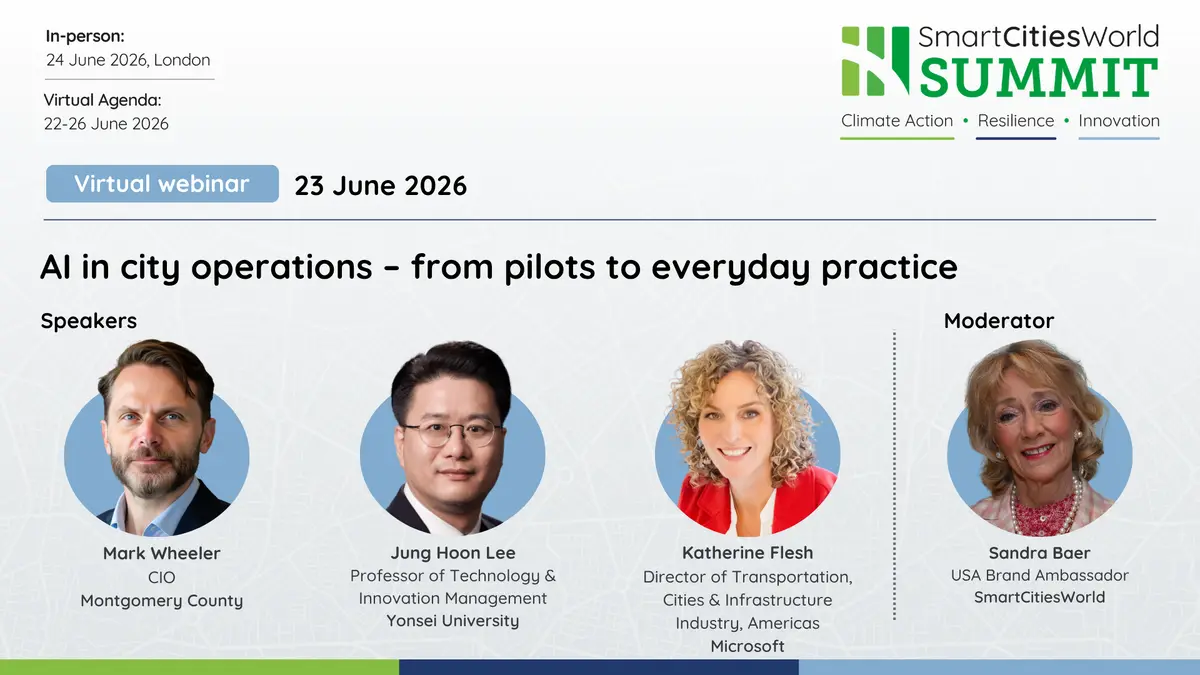
Cities around the world are at a critical inflection point. After years of running artificial intelligence pilot projects with mixed results, local authorities are now asking a harder question: how can AI become a reliable part of everyday urban operations? This is the central theme of the on-demand panel discussion "AI in city operations – from pilots to everyday practice," which brings together urban leaders and technology experts to examine real-world lessons and emerging best practices.
Municipal governments have long recognised the potential of AI to improve public services, from traffic management and waste collection to public safety and energy efficiency. Yet many projects remain stuck in the demonstration phase, never scaling beyond a single testbed. The panel explores why this happens and what has to change, focusing on three interconnected enablers: unified data, agentic AI, and secure digital foundations.
Unified Data as the Critical Foundation
One of the most persistent barriers to AI adoption in city government is fragmented and siloed data. Departments often store information in incompatible systems, making it difficult for machine learning models to gain a comprehensive view of urban dynamics. As a result, even the most sophisticated algorithm can deliver incomplete or misleading insights.
The webinar highlights the need for unified data platforms that bring together datasets from water, transport, energy, public health, housing, and other services. Only when data is normalised, governed, and shared across departments can AI systems detect patterns and support better decisions. This is not just a technical challenge; it also requires new forms of collaboration and trust between agencies.
Agentic AI and the Changing Role of City Staff
Another key theme is "agentic AI"—systems that not only analyse information but also act autonomously or semi-autonomously to execute tasks. In city operations, this might mean an AI system that identifies a failing traffic light and automatically schedules a repair crew, or a chatbot that handles citizen inquiries and learns from each interaction. Agentic AI has the potential to reduce administrative burdens and free up skilled workers to focus on complex problems.
However, the panel carefully notes that agentic AI is not about replacing human judgment. Instead, it is designed to support and amplify workforce decision-making. Local authorities need to create the right human-machine teaming models, ensuring that AI-generated recommendations are transparent, accountable, and subject to appropriate human oversight, especially in safety-critical areas.
Strengthening Infrastructure Resilience with a Risk-Based Approach
Beyond day-to-day efficiency, the on-demand panel is part of a broader Summit 2026 virtual series that focuses on infrastructure resilience. Cities are facing the combined pressures of climate change, ageing infrastructure, and rapid digital transformation. A single extreme weather event can disrupt power, transit, and communication networks simultaneously, revealing how interconnected urban systems have become.
To respond, local authorities are moving away from reactive maintenance and toward a more strategic, risk-based approach to resilience. This uses data and AI to model future climate scenarios, predict which assets are most vulnerable, and prioritise investments accordingly. The result is a more cost-effective and less disruptive way to protect critical services, particularly when budgets are constrained.
AI can also improve real-time situation awareness. Computer vision, IoT sensors, and drone imagery feed predictive models that help emergency services anticipate flooding, heatwaves, or structural failures before they become crises. The aim is not merely to bounce back from shocks, but to adapt and thrive in an unpredictable environment.
Global Examples of Cities Turning AI into Practice
Several examples featured in the article and accompanying panels demonstrate that AI is no longer theorised about; it is already embedded in daily operations in many parts of the world.
Malaysia and the First Southeast Asian Smart City Expo
Malaysia is positioning itself as a regional leader in AI-powered urban innovation. The country hosted the first Southeast Asian Smart City Expo in Kuala Lumpur, an event that gathered technologists, government officials, and investors to showcase practical AI implementations. While the expo highlighted gleaming pilot projects, it also served as a reality check, showing the importance of local context and community engagement. Malaysian cities are testing AI for flood forecasting, intelligent public transit, and digital services that aim to improve the ease of living for all residents.
Singapore’s Smart Nation Journey
Singapore continues to build its reputation as one of the world’s smartest cities. With a national strategy that coordinates data sharing and the deployment of digital infrastructure, Singapore has moved beyond experimental sandboxes. For instance, its Smart Nation Sensor Platform integrates multiple data streams to monitor everything from crowd density to environmental conditions in real time. Regulatory sandboxes have evolved into permanent structures where new AI solutions can be deployed, scaled and refined with full accountability. Singapore’s experience illustrates the power of a cohesive national approach rooted in clear governance and strong institutional capacity.
Sunderland’s Resilient Economy
In the United Kingdom, the city of Sunderland is repositioning itself as a leading smart city, using digital infrastructure and low-carbon innovation to build a resilient, future-focused economy. Sunderland’s approach is closely tied to its ambition to attract high-tech investment and create good local jobs. Its deployment of full-fibre broadband and smart city platforms is not simply about connectivity; it is about creating an environment where small businesses can experiment with AI and where citizens have opportunities to engage with new technologies. The city also places significant emphasis on building trust and co-creating services with residents, understanding that the best technology strategy is one that is shared.
The AI Super Gap and the Global Smart City Index
A central part of the conversation focuses on the emerging "AI super gap" between cities. Professor Jung Hoon Lee, a leading academic observer of cities, has been analysing the results of the Global Smart City Index. He warns that while some cities are racing ahead with advanced AI deployments, others risk falling dangerously behind, lacking both the infrastructure and the governance or institutions needed to keep up.
The professor argues that AI is now moving from pilots to real-world impact, but only in cities that have invested simultaneously in three pillars. First is data platforms and interoperable systems that allow algorithms to access high-quality, secure data. The second is a robust and resilient digital infrastructure that can support computing workloads at a city-wide scale. Third is effective governance that establishes clear rules for procurement, ethical use, privacy, and the roles of both contracted and municipal staff.
None of these pillars is easy to build. Data platforms require long-term funding and changes to procurement frameworks. AI-ready infrastructure often means extending connectivity to underserved communities and adding edge computing capabilities. In terms of governance, there is a need for new skills in the public workforce and sustained political accountability. The "AI super gap" is concerning because it can lead to inequality in public services, with citizens in less-connected cities missing out on better, cleaner and safer services.
Creating Secure Digital Foundations
Security is an essential element of any digital transformation strategy, and this was a recurring theme in the panel. As local authorities come to depend on AI, they also become more exposed to cyberattacks, data breaches, and algorithmic manipulation. Secure digital foundations include encryption, user authentication, and continuous monitoring of data flows, along with the ability to maintain human control in the event of a failure or deliberate attack.
Local governments also have to manage privacy concerns. AI systems for traffic monitoring or public safety often involve the analysis of video and sensor data that may identify individuals. The webinar considered how cities can use privacy-enhancing computation and anonymisation techniques to derive value from data while respecting citizens’ rights. A well-designed digital foundation is one that builds public trust rather than eroding it.
Improving Indoor Safety with Smart Sensor Networks
Sensors are usually associated with streets and traffic, but another area of innovation is indoor safety. Modern buildings—whether they are offices, train stations, hospitals, or schools—now include smart sensor networks that detect risks early, improving situational awareness and contributing to healthier and more sustainable environments.
These systems can detect smoke, air pollution, unusual thermal patterns, or overcrowding and alert managers in real time. In the context of climate change, indoor sensors also support energy efficiency, ensuring that heating and cooling are only active when needed. This reduces carbon emissions and lowers operational costs, providing a clear return on investment. The same infrastructure can be used to guide people during emergencies, using dynamic wayfinding displays and automated alerts that adapt to the location of a hazard.
The View from ST Engineering: Urban AI in Action
One of the featured voices in the article is Gareth Tang, President of Urban Solutions at ST Engineering, a company that provides technology solutions for cities. Tang describes how urban AI applications are set to evolve in the coming years. Many projects are already producing significant impacts: predictive maintenance for railway systems, autonomous security patrols, and smart building automation that may reduce energy consumption by 20% or more.
Tang explains that many cities start with a specific problem, say, detecting water leaks or preventing power outages. Once the proof of concept works, they expand into a broader platform. The challenge, he says, is managing the complexity of integrations and making sure that new AI tools fit with legacy systems. Sustainability and safety must be considered from the start, not retrofitted later. The focus is shifting from small pilots to large, reliable applications where AI becomes a standard part of daily operations, but with clear human accountability.
The Broader Panel Series: Energy Transition and Value from Buildings
The "AI in city operations" webinar is one of a broader set of discussions on how cities can unlock value from buildings, data and AI, and how they can become leaders in the energy transition. In these related conversations, cities are encouraged to move from being passive consumers of energy to system leaders that actively manage production, storage, and consumption using AI-driven optimisation.
Buildings are a particularly important target because they account for a large share of emissions and operational costs. AI can analyse data from building management systems and automatically adjust HVAC controls, lighting, and shading based on occupancy and weather forecasts. This not only cuts energy bills, but also reduces grid strain during peak periods, helping cities avoid blackouts and lowering the need for expensive new power plants. In this way, AI extends beyond the purely digital realm and directly contributes to climate adaptation and resilience.
The final part of the on-demand series will discuss how these different threads connect to broader urban policies. City leaders need to balance the opportunities of AI with the risks and to ensure that no community is left behind. They must be prepared to make difficult choices around data sharing, procurement and public engagement, and they need to learn from each other’s successes and failures.
What makes the current moment distinctive is the maturity of the technology. Cloud computing, machine learning, and sensors are cheap enough to be used widely, and the systems for managing data have improved considerably. Cities no longer need to choose between being innovative and being secure; the two can go hand in hand if the foundations are properly laid. The panel session offers a roadmap and a dose of realism for local authorities at every stage of the journey.
As the examples from Southeast Asia, Singapore, and Europe suggest, the goal of AI in city operations is not to create dramatic headline-grabbing projects, but to make the everyday processes of running a city more efficient and humane. Every successful deployment is a step along a continuum, from pilot to practice, and the lessons from these early implementers are likely to guide the next wave of urban innovation worldwide.
Source:Smart Cities World News