

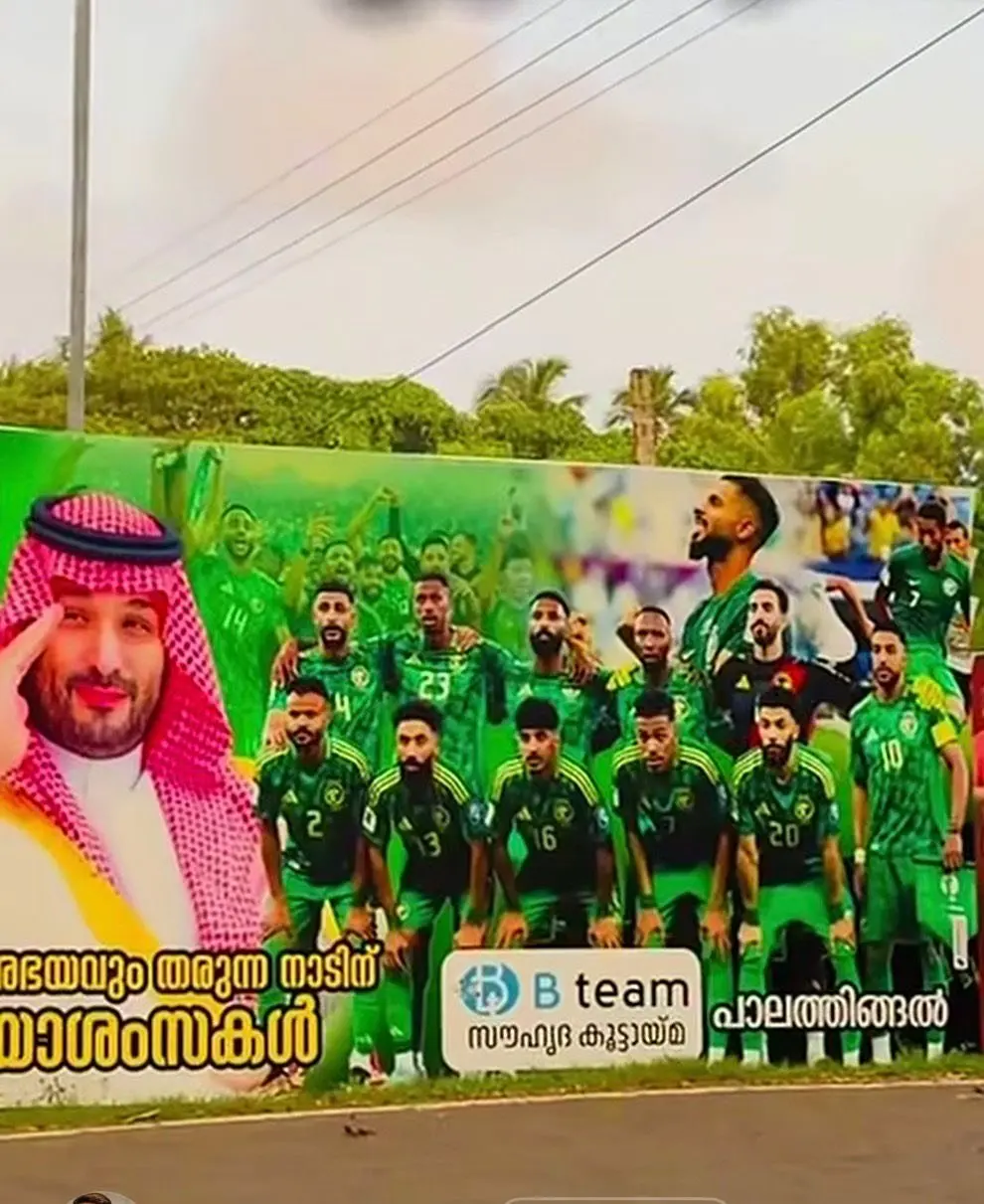
In a remarkable display of cross-cultural solidarity, a village in the Malappuram district of Kerala, India, has erected a large banner featuring Saudi Arabia’s Crown Prince and Prime Minister Mohammed bin Salman alongside players of the Saudi national team. The banner, placed at the entrance of the village, is intended to support the ‘Green Falcons’ as they prepare for the 2026 FIFA World Cup. The image, which quickly went viral on social media, has been widely praised as a testament to the enduring bonds between the Kingdom of Saudi Arabia and the Indian state of Kerala.
Background of the Gesture
The village, whose name has not been disclosed in initial reports, lies within the Malappuram district—a region known for its high rate of emigration to Gulf countries. According to local resident Mohammed Rafeeq, the decision to display the banner stems from the close relationship the villagers share with Saudi Arabia. “A large number of people from Malappuram and Kerala have been working in Saudi Arabia for years,” Rafeeq explained. “This has strengthened feelings of love and gratitude towards the Saudi people.” The banner features a montage of Crown Prince Mohammed bin Salman smiling alongside key players from the Saudi national football team, including captain Salem Al-Dawsari and star striker Firas Al-Buraikan.
The Historic Ties Between Kerala and Saudi Arabia
The bond between Kerala and Saudi Arabia is not a recent phenomenon. For decades, the Gulf region—particularly Saudi Arabia—has been a primary destination for Keralite migrant workers. According to data from the Kerala Migration Survey, approximately 2.5 million Keralites live and work abroad, with a significant proportion in Saudi Arabia. These workers are employed across diverse sectors, from healthcare and engineering to domestic services and construction. The remittances they send home form a crucial part of Kerala’s economy, accounting for nearly 36% of the state’s net domestic product in some years.
Beyond economics, the relationship is deeply cultural. Many Keralites have adopted aspects of Saudi lifestyle, and families maintain strong ties through frequent visits and celebrations of both Islamic and local festivals. The Kingdom has also supported Kerala through humanitarian aid during natural disasters, such as the 2018 floods, further cementing goodwill. This mutual respect was evident when a villager stated, “Many people from Kerala work in Saudi Arabia, so we are with Saudi Arabia wholeheartedly, and we wish success for the Saudi team and all Arab teams.”
The Banner and Its Symbolism
The banner itself is a large, colorful display that covers a significant portion of the village entrance gate. On one side, it shows Crown Prince Mohammed bin Salman dressed in traditional Saudi attire, smiling warmly. On the other side, players of the Saudi national team are depicted in their green-and-white kits, with the team’s logo and the phrase “Go Green Falcons” in both Arabic and Malayalam—the local language of Kerala. The banner was designed by a local artist and funded by contributions from villagers, many of whom have relatives working in Saudi Arabia.
The timing of the banner’s erection is significant. The 2026 FIFA World Cup, co-hosted by Canada, Mexico, and the United States, will mark Saudi Arabia’s seventh appearance in the tournament. The team is placed in a challenging group alongside Argentina, Nigeria, and Iceland—a group that will test their mettle. The villagers’ support comes as Saudi Arabia seeks to advance beyond the group stage for only the second time in history, following their memorable run to the Round of 16 in 1994.
Social Media Reaction
Once shared on social media platforms like X (formerly Twitter), Instagram, and Facebook, the video of the banner garnered thousands of reactions and comments. Users from both India and Saudi Arabia expressed admiration for the gesture. One Saudi user wrote, “This shows that our relationship with India goes beyond business. It is a relationship of the heart.” Another Indian user from Kerala commented, “We always remember the kindness of Saudi Arabia. This is a small token of our gratitude.” The video was also shared by several news outlets in the Gulf region, including Al Arabiya and Saudi Gazette, further amplifying the story.
The Ministry of Culture and Information in Saudi Arabia did not issue an official statement, but informal sources from the Saudi embassy in India acknowledged the gesture as a reflection of the strong people-to-people ties. The embassy’s social media accounts later reposted the video with the caption: “From Malappuram to the world – the love for the Green Falcons knows no borders.”
Broader Context of Indian-Saudi Relations
The banner is part of a larger narrative of improving relations between India and Saudi Arabia. Under the leadership of Crown Prince Mohammed bin Salman, the Kingdom has diversified its foreign policy, strengthening ties with Asian powers including India. High-level visits have become frequent: Prime Minister Narendra Modi visited Saudi Arabia in 2016 and 2019, while the Crown Prince visited India in 2019. During these visits, several agreements were signed in areas such as energy, defense, trade, and technology. The bilateral trade volume between India and Saudi Arabia reached approximately $42 billion in 2023, making Saudi Arabia one of India’s top four trading partners.
Cultural exchanges have also flourished. Saudi Arabia has allowed the construction of Hindu temples for the Indian diaspora, and Indian movies and music are increasingly popular in the Kingdom. The Saudi Vision 2030 reform plan, which emphasizes tourism and entertainment, has opened doors for Indian artists and businesses. In turn, Indian food, fashion, and yoga have found enthusiastic audiences in Saudi Arabia. This mutual cultural appreciation is exemplified by the Kerala village banner—a grassroots initiative that speaks louder than diplomatic communiqués.
The Green Falcons’ World Cup Journey
The Saudi national team, affectionately known as the Green Falcons, has a storied history in the World Cup. Their most famous moment came in 1994 when they reached the Round of 16, defeating Morocco and Belgium before bowing out to Sweden. In the 2022 World Cup in Qatar, Saudi Arabia stunned the world by defeating eventual champions Argentina 2-1 in the group stage, a match that is still celebrated as one of the greatest upsets in tournament history. The team also drew with Poland and lost to Mexico, finishing third in their group.
For the 2026 tournament, Saudi Arabia has qualified under the guidance of Italian coach Roberto Mancini, who took over in 2023. The squad blends experienced veterans like defender Ali Al-Bulaihi with emerging talents such as midfielder Musab Al-Juwayr. The team has also benefited from the increased professionalism of the Saudi Pro League, which has attracted global stars like Cristiano Ronaldo, Karim Benzema, and Neymar, raising the domestic level of play. In preparation for 2026, Saudi Arabia has played friendly matches against top teams from Europe and South America, honing their tactics.
The villagers’ support, therefore, comes at a crucial juncture. As the team prepares to face tough opponents, the emotional boost from fans thousands of miles away can be a source of inspiration. In an interview with a local news channel, one of the village elders said, “We may be in a small village, but our hearts are with the Green Falcons. We pray for their success, and we hope our banner gives them strength.”
Why Kerala? A Closer Look at the Diaspora
Kerala’s strong ties with the Arab world are rooted in history. For centuries, Arab traders visited the Malabar Coast, and the region’s Muslims have long maintained links with the Arabian Peninsula. In modern times, the oil boom of the 1970s triggered large-scale migration of Keralites to the Gulf. Today, nearly 90% of India’s emigrants to Saudi Arabia come from Kerala and the neighboring states of Tamil Nadu and Andhra Pradesh. The state government has even established a Department of Non-Resident Keralite Affairs (NORKA) to address the needs of its diaspora.
These Keralites have integrated well into Saudi society. Many speak Arabic, observe local customs, and contribute to the Kingdom’s economy. In return, Saudi Arabia has provided them with lucrative job opportunities and a safe environment for their families. The remittances sent back to Kerala have funded everything from new homes to educational institutions. This symbiotic relationship has created a strong emotional bond—one that the banner in Malappuram vividly illustrates.
Comparative Gestures Across the Region
The Kerala banner is not an isolated incident. Across India, similar gestures of goodwill toward Saudi Arabia have been observed. In the past, Indian football fans have waved Saudi flags during friendlies, and Indian businesses have sponsored Saudi teams. In 2023, a group of students in Hyderabad painted a mural of Crown Prince Mohammed bin Salman and Indian Prime Minister Narendra Modi shaking hands, symbolizing the partnership. However, the Kerala banner stands out because it comes from a rural community with direct personal ties to the Kingdom.
In Saudi Arabia, Indians are the largest expatriate community, numbering over 2 million. They play a vital role in sectors such as healthcare, construction, and information technology. Indian doctors and nurses form the backbone of many Saudi hospitals, while Indian engineers have contributed to mega-projects like NEOM and the Red Sea Project. The Kerala banner, therefore, is a reciprocal gesture of appreciation from a community that has benefited immensely from these opportunities.
Looking Ahead: The Impact of Such Initiatives
Initiatives like the banner in Malappuram have the potential to strengthen people-to-people ties further. They humanize international relations and remind us that diplomacy is not only about treaties and trade agreements but also about mutual respect and friendship. As the world becomes more interconnected, such grassroots expressions of solidarity will likely become more common. For Saudi Arabia, the support from Kerala serves as a soft-power boost, showcasing the Kingdom’s positive image abroad.
For the villagers, the banner is a source of pride. They have received calls from relatives in Saudi Arabia expressing happiness and gratitude. Some have even suggested sending a copy of the banner to the Saudi team’s camp in the United States. The local self-government has proposed making the banner a permanent fixture, to be updated for future tournaments. As one villager put it, “This is not just about football. It is about our bond with Saudi Arabia, a bond that we want to show the world.”
The 2026 World Cup will begin in June, and the villagers plan to organize viewing parties. They have already collected funds to install a large-screen television in the community hall. Whether Saudi Arabia wins or loses, the relationship between Kerala and the Kingdom will remain strong. The banner is a symbol of that enduring friendship—a friendship that transcends borders, languages, and sports.
Source:Sabq News News