

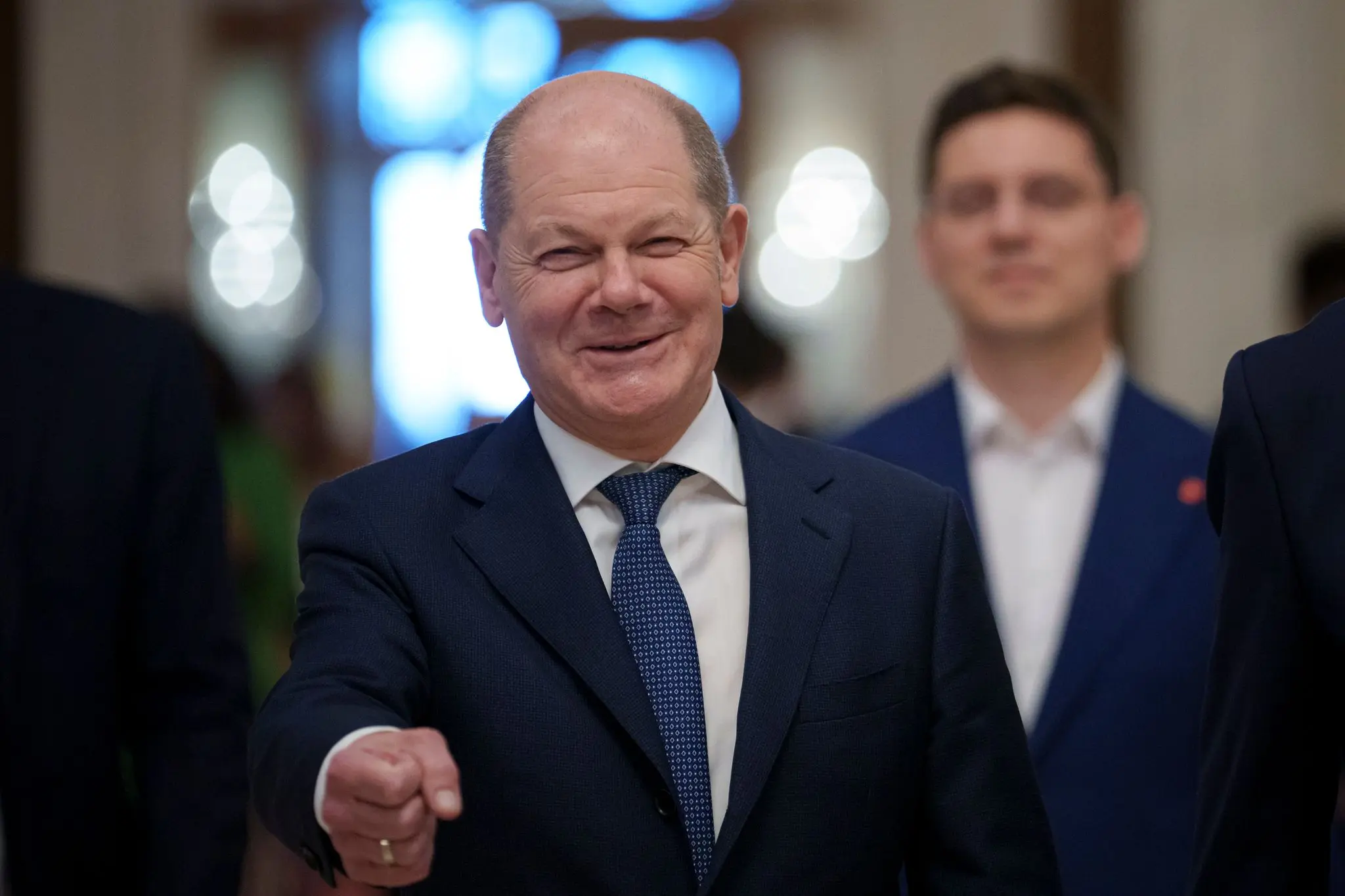
German Chancellor Olaf Scholz arrived in China on Sunday, April 14, 2024, for a three-day visit dominated by trade tensions and stark differences over Russia’s invasion of Ukraine. His first stop was the industrial city of Chongqing, where the delegation, including ministers and business leaders, was scheduled to tour a partially German-funded company and other sites in the vast municipality known as a production base for China’s automotive and manufacturing industries.
From Chongqing, Scholz was due to travel to Shanghai, China’s financial hub, before ending the visit in Beijing for talks with Chinese leader Xi Jinping and Premier Li Qiang. The trip is Scholz’s second to China since he became chancellor in late 2021. His previous visit, in November 2022, was essentially a one-day trip because of the strict COVID-19 restrictions that were still in place at the time.
A relationship under strain
The visit comes at a difficult moment in Germany-China relations. German companies such as BMW and Volkswagen remain heavily dependent on the Chinese market, but the economic relationship has become more complicated in recent years. Chinese companies are increasingly competing with German manufacturers in automobiles, chemicals, and green technology. At the same time, German businesses have complained about unfair market access, regulatory hurdles, and political interference in China, which they say has contributed to a sharp drop in foreign investment.
In response, the German government has promoted a policy of “de-risking,” designed to reduce Germany’s reliance on China as a market and supplier while avoiding a complete break. The strategy reflects a broader European concern that economic dependencies built over decades could become vulnerabilities, especially as Beijing grows more assertive in trade, technology, and foreign policy.
Despite those worries, China remained Germany’s top trading partner for the eighth consecutive year in 2023. According to Germany’s Federal Statistical Office, goods and services worth 254.1 billion euros (about $271 billion) were exchanged between the two sides in 2023. That was slightly more than Germany traded with the United States, but it still represented a 15.5 percent contraction compared with the previous year. German exports to China totaled 97.3 billion euros (around $104 billion), although the exact figures vary due to exchange rate fluctuations and rounding.
The trade data underscores the dilemma facing Scholz’s government. While Germany wants to protect its economic interests and supply chains, it also wants to reduce its strategic vulnerability to Beijing. The balancing act has become harder as China deepens ties with Russia and refuses to criticize Moscow’s war in Ukraine.
Ukraine divides Germany and China
Scholz’s arrival in China was framed by the war in Ukraine. On social media platform X, Scholz said he had discussed the “massive” Russian air attacks on civilian energy infrastructure with Ukrainian President Volodymyr Zelenskyy on Saturday. He declared that Berlin will “stand unbreakably by Ukraine’s side.”
China has refused to condemn Russian aggression. Beijing has maintained trade relations with President Vladimir Putin’s government and has aligned its foreign policy with Moscow in opposing the U.S.-led liberal international order. Chinese officials have repeatedly called for negotiations and a political settlement, but they have also declined to acknowledge Russia as the aggressor in the war. That position has created friction with Germany and other Western powers.
During the visit, Scholz was expected to raise the Ukraine issue directly with Chinese leaders. However, there was little expectation that China would change its stance. The EU has called on China to use its influence over Russia to help end the war, but Beijing has shown no sign of shifting its position.
Chongqing: industrial powerhouse and symbol of China’s manufacturing
Chongqing, a municipality of more than 30 million people, is one of China’s most important industrial centers. It is a major hub for automobile production, electronics, and heavy machinery. The city is also partly surrounded by the Yangtze River and its tributaries, and it is known for its dramatic hillside landscape.
Scholz’s itinerary in Chongqing included a visit to a hydrogen motor production facility run by the German company Bosch. Hydrogen technology is seen as a key area for future energy transition, and Germany has been seeking to strengthen cooperation with China in green technologies despite the broader tensions.
After visiting the Bosch facility, Scholz toured the city with young architects and was scheduled to take a boat cruise on the Yangtze River. The choice of Chongqing was significant: it allowed Scholz to see China’s industrial capacity outside the traditional coastal economic centers while also symbolizing the deep economic ties that remain between Germany and China.
Chongqing has also become a focal point for German business. Several German companies operate in the region, and the state government of Baden-Wuerttemberg, home to carmakers like Mercedes-Benz and Porsche, has long maintained ties with the city. The visit was therefore carefully designed to highlight cooperation in innovation, sustainability, and urban development.
Shanghai and Beijing: meetings at the highest level
In Shanghai, Scholz was expected to meet with business representatives and discuss Germany’s economic interests in China. Shanghai is the country’s financial center, and many German banks, insurers, and industrial firms have their Chinese headquarters there. The visit was an opportunity to gain exposure to Chinese business and local officials, as well as to assess the mood among foreign investors who have become increasingly wary of operating in China.
The final leg of the visit took Scholz to Beijing, where he was scheduled to meet Xi Jinping at the Diaoyutai State Guesthouse, a resort-like compound used for high-level diplomatic occasions. He was also to be received with military honors by Premier Li Qiang at the Great Hall of the People, the seat of China’s ceremonial legislature in the center of the capital. Further meetings and engagements were planned before his departure late on Wednesday night.
The Beijing meetings were seen as the most important part of the trip. Xi rarely meets foreign leaders, and his decision to meet Scholz signaled that China still places value on the relationship with Germany, even as tensions mount. For Scholz, the meetings were a chance to communicate directly on trade, Ukraine, and human rights concerns.
Germany’s China strategy and the road ahead
The visit was Scholz’s first since the German government unveiled its comprehensive China strategy in 2023. The strategy calls for a more consistent and coordinated approach to China policy across federal and state levels. It emphasizes the need to reduce dependency in critical areas while maintaining an open dialogue and fair competition.
Beijing has criticized the strategy, viewing it as an attempt to contain China’s rise. Despite the friction, high-level contacts have continued. Premier Li Qiang and a delegation of senior officials visited Berlin in June 2023, and Scholz’s current visit marked another step in maintaining the bilateral relationship.
Germany’s business community has watched closely. Many executives still view China as an indispensable market and a key part of global supply chains. However, they also acknowledge that the era of unquestioning engagement is over. German companies are now reviewing their exposure and, in some cases, diversifying production to Southeast Asia or other regions.
The question at the center of Scholz’s visit was whether Germany and China can manage their differences without breaking the economic ties that have benefited both sides for decades. The answer is by no means certain. Trade tensions over electric vehicles, subsidies, and market access are likely to persist. The Ukraine conflict will continue to color the relationship. And China’s political system remains incompatible with the values and interests of Germany and the European Union.
Yet the fact that Scholz chose to travel to China, even at a time of such strained relations, says as much. Both sides appear to believe that direct dialogue is better than distance. Whether that dialogue can produce concrete outcomes remains uncertain, but the visit itself may serve as a moment to recalibrate expectations on both sides. For Germany, it is a chance to press for fairer market access and to explain its concerns about the war in Ukraine. For China, it is an opportunity to show that it remains open for business and willing to engage with the world’s largest economies. The next few years will determine whether those overlapping interests are enough to sustain a relationship that has yet to face tests as severe as the ones now unfolding.
Source:The Asahi Shimbun News