

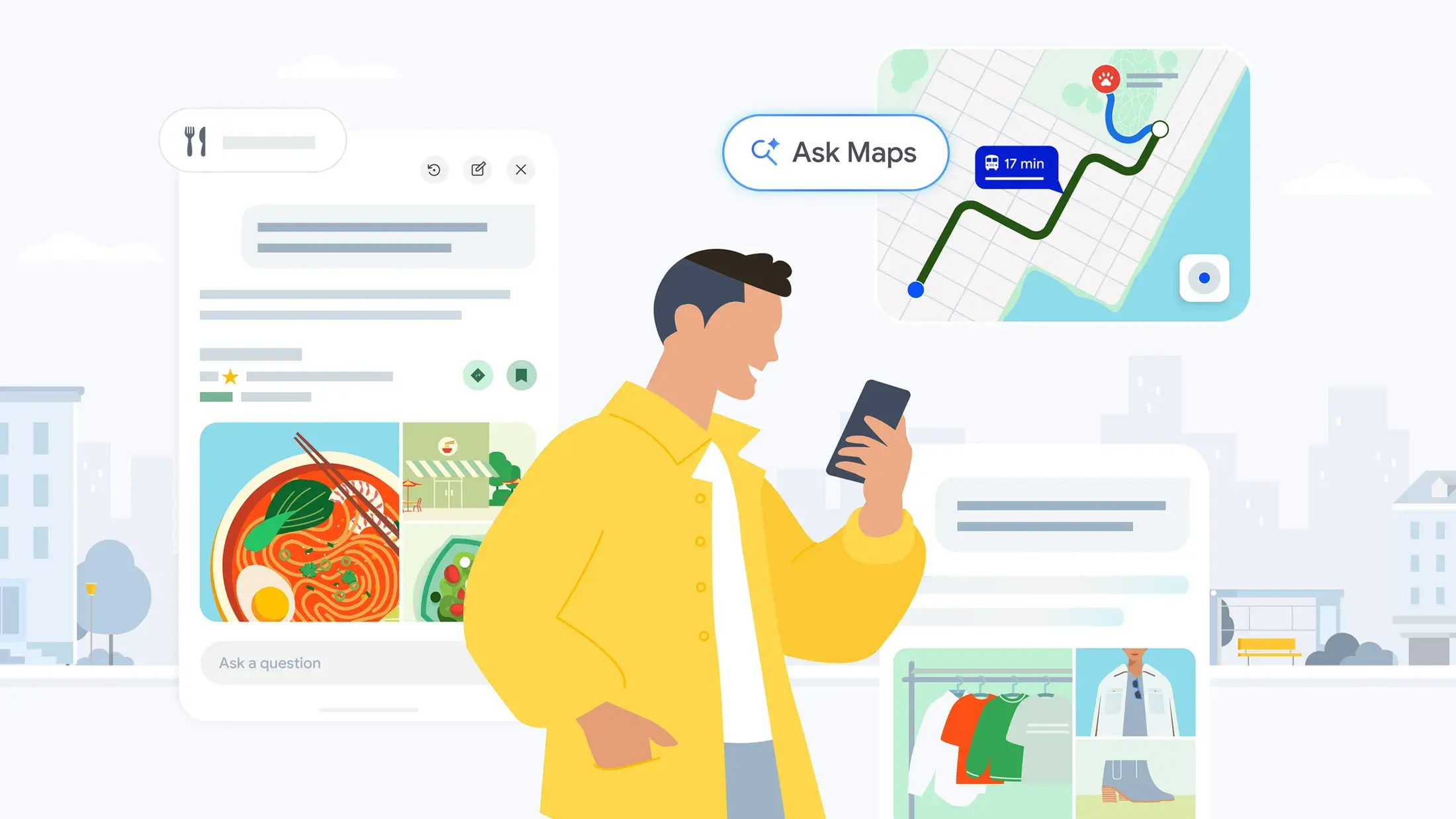
Google Maps has long been the go-to tool for discovering places and navigating between them. But a new generation of artificial intelligence features is turning the app into a transactional travel platform, capable of ordering meals and booking hotel rooms through natural conversation. The update reflects a broader industry shift toward agentic AI, where assistants do more than suggest and actually complete tasks on behalf of the user.
Key Facts at a Glance
- Google Maps now uses conversational AI to understand complex requests like 'find a pet-friendly hotel with a pool near downtown' or 'order sushi from a place that delivers within 20 minutes.'
- The food ordering feature is integrated with restaurant partners and delivery services, allowing users to pay and track orders without switching apps.
- Hotel search has moved beyond simple filters, enabling users to compare amenities, prices, and availability in a chat-style interface and book directly.
- These capabilities are part of a larger rollout of Google's AI Mode, which embeds Gemini-powered reasoning into Search and Maps.
- Analysts see the move as a direct challenge to standalone travel agents, food delivery apps, and online travel agencies like Expedia and Booking.com.
From Directions to Daily Life Concierge
For more than a decade, Google Maps focused on navigation: finding the fastest route, avoiding traffic, and exploring nearby businesses. Over time, it added reviews, business hours, and reservation links, but it remained largely a reference tool. The new AI features change that equation. Instead of merely pointing users toward a restaurant or a hotel, Google Maps now acts as an agent that can execute the entire transaction. A user can type or speak a request in plain language, review AI-generated recommendations, and complete a booking without ever leaving the Maps interface.
This evolution is powered by large language models and the same technology behind Google's broader AI investments. The system synthesizes data from millions of business listings, user reviews, Web results, and real-time inventory feeds to provide personalized answers. For example, a family on a road trip might ask: 'We're stopping in Barstow for lunch. Find a place that has high chairs and quick service.' The AI can analyze photos, menus, review sentiment, and current busyness to return a ranked set of options. If the user picks one, they can tap to order directly, with payment handled through Google Pay or the restaurant's own systems.
Ordering Food Without App Hopping
Food delivery has become a crowded market, with players like Uber Eats, DoorDash, and Grubhub competing for consumer attention. Google Maps already had some integration with these platforms, but the new AI-driven flow is far more seamless. When a user searches for a type of cuisine or a specific dish, Maps can show relevant restaurants that are currently accepting delivery orders. The AI can also answer follow-up questions, such as 'Does this place have vegetarian options?' or 'How long has this restaurant been open?' rather than forcing the user to open multiple tabs.
The system makes use of structured data from restaurant partners, including menus, prices, allergies, and average preparation times. In many cases, the order is sent directly to the restaurant's point-of-sale system, reducing the risk of missing items. The user can set a pickup time, pay for the meal, and receive notifications about the order status. This integration turns Google Maps into a front-end for the entire restaurant discovery and ordering experience, similar to what standalone delivery apps have offered but with the added advantage of local context and rich mapping data.
For local restaurants, the feature could be a double-edged sword. On one hand, it makes them visible in a wider range of searches and captures demand from tourists and passersby. On the other hand, it further consolidates the ordering flow inside Google's ecosystem, potentially reducing direct traffic and commission costs. Restaurants will need to ensure that their menus and hours are accurate and that they have the technical infrastructure to accept third-party orders. Early adopter feedback suggests that businesses with up-to-date Google Business Profiles see significantly higher conversion rates through the new interface.
Hotels, Room Service, and the New Search Booking Flow
The hotel booking portion of the AI upgrade is equally ambitious. Searching for a place to stay is usually a multi-step process: check OTAs, compare prices, read individual reviews, and finally book. Google Maps new AI Mode streamlines this journey. A user can type 'Find a hotel in Portland with free parking and an EV charger' and receive a curated list of properties that meet those exact criteria. The AI can then answer nuanced questions about room sizes, cancellation policies, proximity to landmarks, or whether the hotel has a fitness center.
Once a user selects a hotel, the booking flow is presented directly in the interface. In some cases, the reservation can be made through Google's own partnerships with property owners, while in others, the user is seamlessly redirected to the hotel's native booking engine. The key difference from traditional search is that the AI remembers the context and can compare multiple options in a side-by-side view, making it easier for travelers to understand value. For instance, a traveler might ask: 'Which hotel is cheaper, the one near the airport or the one downtown?' The AI can calculate the total price including taxes and present a comparison with pragmatic details like estimated commute times.
This is a significant step toward what Google has called 'AI Mode' in search, where users can have a multi-turn conversation rather than entering a single query. Rather than ten blue links, the user gets synthesize answers, actionable maps, and booking buttons. In a recent demonstration described by tech analysts, a user asked Maps to plan a weekend trip to Austin, Texas, including a live music venue, a barbecue restaurant for Saturday dinner, and a hotel within walking distance of both. The AI produced an itinerary with reservation links, opening the potential for any part of the plan to be completed with a single tap.
What This Means for Travelers
From the consumer's perspective, the biggest advantage is convenience and personalization. Travel planning often involves moving between apps, copying addresses, remembering login credentials for multiple services, and weighing conflicting reviews. AI-powered Maps can handle those tasks in one place. It can factor in user preferences based on past restaurant orders, saved addresses, calendar events, and even public transit data to suggest more relevant results. A user who frequently visits vegan restaurants is more likely to see plant-based options; a parent traveling with small children may see hotels that offer cribs and soundproof rooms.
Transparency is also important. The AI is designed to show why a given recommendation was made, citing specific review snippets and attributes. This gives travelers some degree of confidence that the result is not arbitrary. However, it also raises concerns about sponsored placement. If Google eventually allows hotels and restaurants to pay for visibility inside AI-generated responses, the distinction between organic recommendation and advertisement could blur. Regulators in Europe and the United States are already scrutinizing how large platforms rank their own services, and AI-driven travel booking will likely attract similar attention.
Under the Hood: Gemini and Multimodal AI
Much of the technology behind these features comes from Gemini, Google's family of multimodal large language models. Gemini can process text, images, audio, and video, which allows Maps to understand visual cues like a hotel lobby photo or a restaurant menu scanned through a smartphone camera. The model is also capable of reasoning across structured data sets, such as geo-location boundaries and business hours, and unstructured content, such as customer reviews written in a natural language. This hybrid reasoning is essential for complex travel queries that require real-world constraints.
The integration with Google Search means that Maps AI can draw on the Knowledge Graph, real-time traffic data, and business listing information from all over the world. It also learns continuously from user interactions, but Google has been careful to frame this within the bounds of privacy expectations. The company states that AI enhancements are built with user trust in mind, and that personalized features require active consent. Even with those safeguards, privacy advocates have urged caution, noting that location history and payment data could be combined to create extremely detailed profiles of a user's movements, spending habits, and daily routines.
The Competitive Landscape
Google Maps is not entering this field alone. Apple Maps has introduced more detailed mapping and indoor navigation, but it has not yet embedded transaction capabilities in the same way. Amazon has entered the travel search space with partnerships for hotel booking, though it does not have a mapping interface. The most direct competition comes from online travel agencies such as Booking.com, Expedia, and TripAdvisor, all of which are investing in AI assistants to help users plan their trips. However, these platforms typically lack the local search and navigation depth that Google Maps possesses.
There is also a new generation of AI-native travel startups, such as Layla and Mindtrip, that are developing conversational planning tools. These startups aim to create a personalized itinerary over chat, with rich visuals and direct booking links. Google's advantage is distribution: billions of users open Maps every day, and many already use it to look up restaurants and hotels. By adding a seamless transaction layer, Google can capture a significant portion of the travel commerce pie before standalone AI startups have time to scale.
Privacy and Trust in the AI Travel Era
With convenience comes new privacy considerations. To suggest the best restaurant or hotel, the AI needs data about a user's location, preferences, past behavior, and sometimes even their schedule. Google has repeatedly emphasized its commitment to on-device processing and data minimization. Some features rely on on-the-fly reasoning while others use cloud-based LLMs, meaning that request text may be sent to remote servers for processing. Users must be aware of how their queries are stored and used. In 2024 and 2025, several consumer groups and regulatory bodies questioned the opacity of AI-generated answers, especially when they involve commercial transactions.
Another layer of trust is related to content reliability. AI systems can hallucinate or present outdated business hours and prices. Google has implemented technical safeguards such as linking to sources and allowing businesses to claim and update their information. But for a user who orders a meal and arrives at a restaurant that has closed, the frustration can undermine confidence in AI-powered commerce. Google is betting that its continuous feedback loops and business verification tools will mitigate these issues, while competitors watch to see whether the agentic experience truly delivers on its promise.
The expansion of AI-powered Maps also raises a broader question about the future of human decision-making. When an algorithmic concierge narrows down a city's dining options to just three recommendations, does it broaden or limit our horizons? Proponents argue that AI removes the overwhelming noise of choice, helping travelers discover options they might have missed. Critics counter that personalization based on past behavior creates a algorithmic bubble, pushing users toward familiar cuisines and accommodations rather than truly novel experiences. Design choices in the Maps interface, such as the number of suggestions presented and the explanatory language used, will go a long way toward determining whether the tool feels like a helpful guide or a manipulative salesperson.
For now, the rollout is occurring gradually across mobile and Web, with generative AI features layered onto existing Maps functions. Early users are already testing the ability to ask for 'somewhere with a fireplace and a good margarita' or 'a boutique hotel in Brooklyn under $300,' and the results signal a shift from search engines to action engines. As hotels and restaurants connect their inventory to this new ecosystem, the convenience gap between a simple map and a full-service travel agent will continue to shrink.
With every new update, the line between navigation, search, and commerce becomes harder to draw. The AI-powered Google Maps is not just ordering food or finding hotel rooms; it is learning how to anticipate what users actually need, often before they finish typing. Whether it is an impromptu sushi dinner or a cross-country business trip, the next few years will show whether consumers are ready to hand over the entire itinerary to a chat interface that is only getting smarter.
Source:Techopedia News