

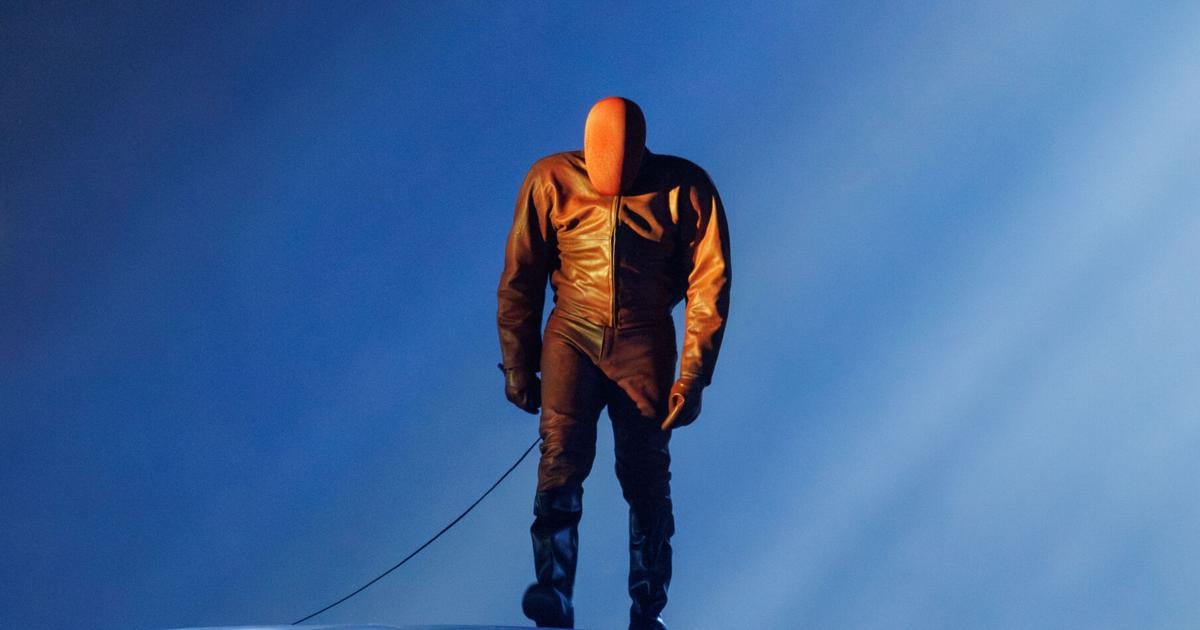
After months of handwringing and anticipation, Ye—the artist formerly known as Kanye West—finally took the stage at the Caesars Superdome in New Orleans on Friday, Aug. 28, 2026. The result was everything his fans hoped for and nothing his critics feared: innovative, inscrutable, idiosyncratic, infuriating and, at times, invigorating, all wrapped in a spectacle that was both grand and strangely intimate.
The concert had been surrounded by controversy long before the first note sounded. Ye’s recent years have been marked by a series of antisemitic pronouncements and gestures, which led many in the local Jewish community to urge caution. A small protest was staged outside the venue, with demonstrators lighting Shabbat candles in opposition to his performance. But inside the Dome, the night unfolded with no controversial statements at all. In fact, Ye said nearly nothing to the crowd, letting the music and the visual spectacle speak for themselves.
A Stage Built for a Star
The Superdome was not completely sold out, but a last-minute surge of ticket sales and giveaways pushed attendance past 50,000—an exact figure was never released. It was one of the most evenly integrated concert crowds the city has seen in years, a testament to the broad cultural reach of Ye’s two-decade-long career.
The stage itself was the evening’s most talked-about element. It looked like the top half of the Las Vegas Sphere had been lopped off and set down in the middle of the Dome floor. Continents, clouds and oceans drifted across the surface of the three-story-tall sphere, positioning Ye literally on top of the world. It was the most impressive prop deployed in the Dome since Beyoncé’s 60-foot cube from the Formation World Tour a decade earlier.
A tall, white, circular curtain slowly dropped to a dramatic overture to open the show. Ye emerged atop the sphere to perform “King,” from his inconsequential 2026 album “Bully.” For the next 50 minutes, he wore a featureless ski-mask-like head covering without openings for his eyes, nose or mouth. He could have been anybody up there, and that seemed to be the point. He was simultaneously larger than life and an anonymous speck of a man.
Most in the Dome experienced Ye only as a small, distant figure, because he was never projected onto any screen for the majority of the performance. His movements were measured, modest and deliberate, as he was confined to the very top of the sphere. He stood motionless, rocked back and forth at the knees, or walked in slow, tight circles while tethered to a safety harness. This was an inverse kind of charisma—anti-charisma, perhaps—but it worked in the context of the show.
A Setlist Spanning Decades
Across nearly two hours, Ye presented three dozen songs in whole or in part. His recent album “Bully” and his landmark, multi-million-selling 2007 album “Graduation” were the most heavily represented, with five songs apiece. The music was prerecorded, and it was impossible to tell how much or how little Ye was actually rapping live. But the excitement came from the songs themselves and the sheer ambition of the production.
The opening notes of “Can’t Tell Me Nothing,” from “Graduation,” electrified the audience even as Ye maintained his statue-like demeanor. The contrast was its own kind of theater. The sphere then went dark, and the energy cooled for the techno bleeps of “On Sight.” Red lighting bathed the sphere for “Blood on the Leaves.”
The ring curtain was hoisted above the stage to become a projection screen as rapper Ty Dolla $ign, a frequent Ye collaborator in the duo Y$, joined him on the globe for three songs: “Everybody,” “Carnival” and “Fade.” In the night’s only real address to the crowd, Ye said, “Make some noise for Ty Dolla Sign, y’all.” The moment was brief but warm.
The sphere switched to jerky, grainy, black-and-white footage of Ye during “Heartless,” but he remained largely inscrutable. The lighting design treated the Dome’s interior as one large canvas, with rows of dozens of spotlights suspended from the rafters creating walls of light. Lights around the circular base of the sphere sketched a cone that stretched to the ceiling.
A few weaker moments emerged, including a lukewarm reception for “All the Love,” a mediocre cut from “Bully.” But momentum picked up again for “Power,” and indoor fireworks popped off for hard-hitting “Jesus Walks” as the setlist shifted into a hit parade. The uncluttered rapping atop the irresistible beat of “All Falls Down” played particularly well, and Ye paired “Gold Digger” and “Touch the Sky” from his classic “Late Registration” album.
During “All of the Lights,” dozens of lasers erupted from numerous points around the floor, crisscrossing and filling the Dome’s airspace. It was as if all the lasers deployed throughout the whole history of heavy metal had been incorporated into this one hip-hop show. For “Stronger,” the video Earth on the sphere spun at a dizzying pace, and after “Ghost Town,” Ye disappeared into the sphere, only to ascend again with a synthesizer-type device on a stand.
A Poignant Ending
A single, plunked piano note elicited a roar of recognition: this was “Runaway,” from his 2010 opus “My Beautiful Dark Twisted Fantasy.” Ye crafted that album in the wake of a public backlash sparked by his interruption of Taylor Swift’s acceptance speech during the 2009 MTV Video Music Awards. The album explored issues of ego and fame—an especially toxic combination when coupled with mental illness.
For the first time, the circular screen projected an up-close view of Ye, without a mask, leaning into a microphone and the confessional lyrics. Those lyrics are even more relevant now than when he wrote them 16 years ago. “I know I did damage,” the song’s protagonist admits, but he is not inclined, or able, to repent or change. Instead, he suggests to his significant other that “when it starts to get crazy, run away… run away as fast as you can.”
The tens of thousands of fans in the Superdome seemed inclined to stick with him. The night’s final image was of Ye standing atop his glowing sphere, the lights dimming around him as “Runaway” faded into silence. No manifesto, no apology, no redemption arc—just the music, the spectacle and the unresolved contradictions of an artist who has spent a lifetime making peace with his own chaos.
For those who came expecting controversy, it never arrived. For those who came expecting a typical concert, they got something far more unusual. Ye, as always, did it his way, on his own terms, leaving the crowd with a great deal to ponder long after the Dome emptied out.
Source:NOLA.com News