

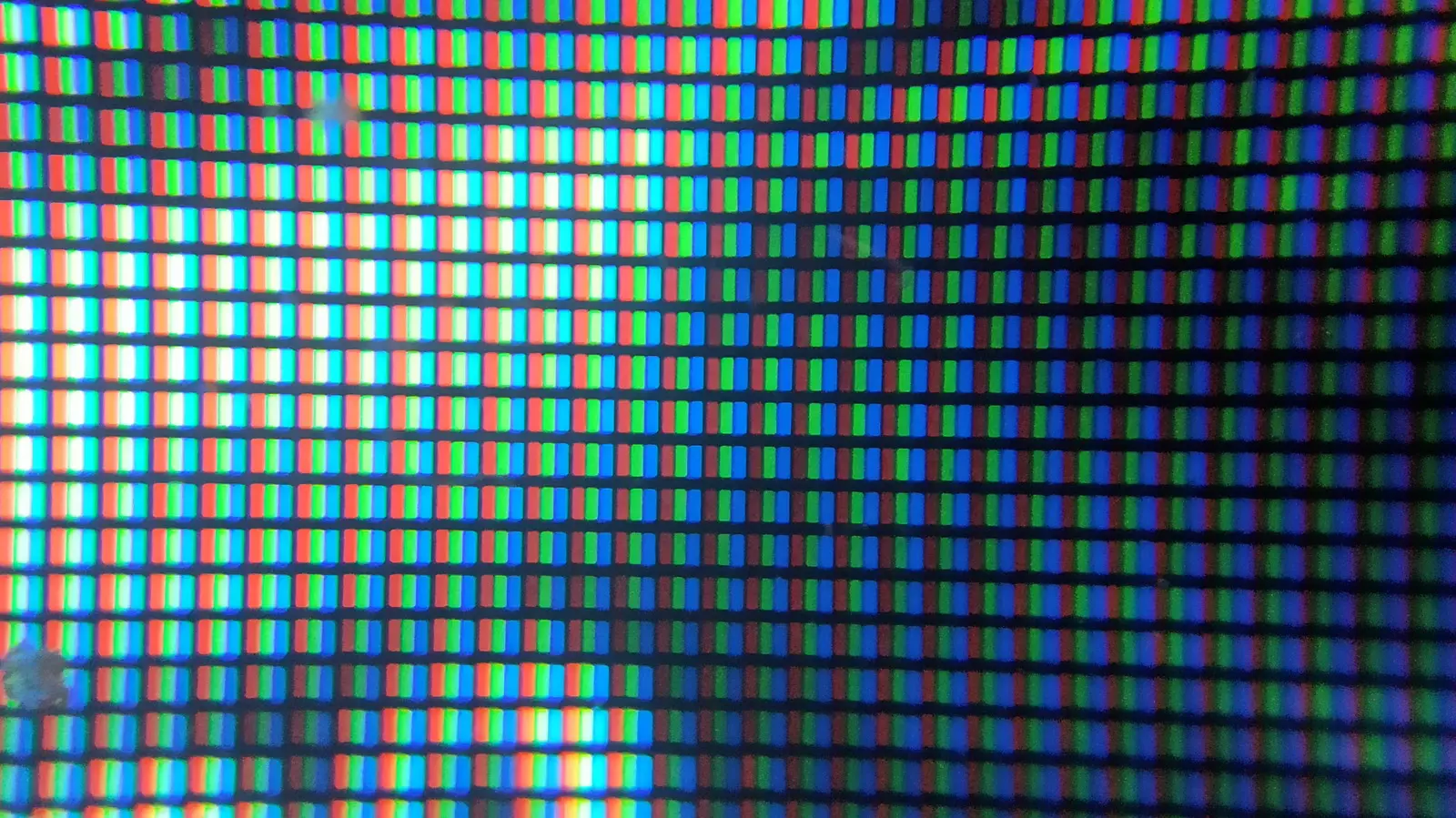
There's no denying that smartphone displays today are simply gorgeous, thanks to their use of AMOLED (Active Matrix Organic Light Emitting Diode). But if they are so great, then why does the TV in your living room stick with OLED instead? You may have heard them use tech like WOLED or QD-OLED, but none of them ever get branded as AMOLED. Now, that's not to say your TV uses an entirely different technology, since it still uses an active matrix — so, it's technically an AMOLED at heart. It just doesn't use the same recipe phones do, and there are a few good reasons for that.
First, it's important to understand what makes AMOLEDs unique. These still are OLEDs, except the way AMOLEDs work is with the active matrix screen tech doing the heavy lifting. Active matrix refers to a grid of thin-film transistors, or TFTs, that sit behind the screen. Their job is to give every single pixel its own switch, which is pulled off by handing it a transistor or two, plus a capacitor to hold the charge. The point is to make the picture look sharper and more responsive.
Driving those self-lit pixels takes a steadier and stronger current than the older transistors used to be able to supply, though. So to help with that, AMOLEDs on phones also rely on a transistor process called LTPS, which is short for low-temperature polycrystalline silicon. Now, while LTPS works just fine on smaller displays, it doesn't scale well to bigger ones due to its complexity. So when you put it all together, the very stuff that makes a phone screen shine is also what keeps it from blowing up to TV size.
Going big breaks the recipe
The thing is that OLED is already delicate enough with all those organic materials crammed inside. They can all be wrecked pretty easily by contamination and moisture. In fact, even one slip during production will render the panel useless. These factors only multiply when the panel is stretched to something like 65 inches, greatly increasing chances for flaws to crop up.
While TVs skip the kind of AMOLED setup on phones, it's not necessarily a bad thing. TVs have wandered down their own evolutionary path, and they lean on different technologies to achieve a crisp, colored picture. Phones still use that LTPS backplane, but the bigger screens have switched over to a different one built on oxide semiconductors.
Phones build color by laying down three separate glowing materials, one for red, one for green, one for blue. Manufacturing like that at TV size is a huge hassle, though. So display makers have started taking different approaches instead. Let's take a look at two of them.
There are workarounds for the problem, though
LG has come up with WOLED, which is white OLED paired with color filters. The OLED layer on these panels only produces white light. Colored filters then change this white to red, green, and blue along the way (by filtering out other colors), effectively removing the need for separate colored pixels for each. The filtration in question is achieved with the use of colored resins. There's also a fourth white subpixel at play here, which exists to push the brightness higher. The best part about it all is that it's easier to produce, so yields are way better than what you'd get with true RGB.
Then there's Samsung, which has a very different way of achieving RGB compared to LG. The company uses QD-OLED – short for Quantum Dot OLED. This one kicks off with a special blue OLED light source. But instead of using color filters, it uses these quantum dots, which are essentially tiny particles that shift light from one color into another. This allows them to conjure up the reds and greens. Since color filters are out of the picture here, and because they can hurt brightness, compared to WOLED, QD-OLED is said to reach high brightness levels without losing much contrast. However, LG has quashed any brightness concerns with a newer, stacked Tandem WOLED technology it's now fitting its latest TVs with.
To fully understand why TVs avoid the AMOLED label, it helps to dive deeper into the manufacturing challenges. The LTPS backplane used in smartphones requires multiple high-temperature annealing steps to create the polycrystalline silicon layer. This process becomes increasingly difficult and expensive as the substrate grows. Defect rates soar, and the uniformity of the transistors across a large area suffers. That's why TV makers turned to oxide semiconductors like IGZO (indium gallium zinc oxide). IGZO offers better uniformity and lower leakage current, making it ideal for large, high-resolution displays. It also consumes less power than LTPS, which is a bonus for a device that's always plugged into the wall.
Another factor is the color patterning method. In smartphone AMOLEDs, the red, green, and blue organic materials are deposited through fine metal masks (FMM) – essentially stencils that allow the emissive layers to be patterned precisely. However, these masks are expensive to produce and prone to sagging or misalignment when used on large substrates. For a 6-inch phone screen, the masking is manageable; for a 65-inch TV, it becomes a nightmare. That's why WOLED and QD-OLED avoid fine metal masks entirely. WOLED uses a single white emissive layer with color filters added on top, while QD-OLED uses a blue emissive layer with quantum dot color converters. Both approaches eliminate the need for FMM, greatly reducing production complexity and cost.
Beyond manufacturing, there are also performance trade-offs. The LTPS backplane allows for extremely fast switching, which is why smartphones can achieve high refresh rates and smooth touch response. But for TVs, which are typically viewed from a distance, the refresh rate requirements are similar, and oxide backplanes can easily handle 120Hz or 240Hz. The main advantage of LTPS – its high electron mobility – becomes less critical when the pixel density is lower. TV pixels are much larger than phone pixels, so the transistor doesn't need to be as fast to charge the pixel capacitor in time.
Another aspect is burn-in risk. AMOLED displays are susceptible to permanent image retention when static elements are displayed for long periods. Smartphone users often see this on status bars or navigation buttons. TVs are even more prone to burn-in because they're used for hours with channel logos, news tickers, or game HUDs. Manufacturers have implemented various techniques to mitigate burn-in, such as pixel shifting, dimming static areas, and using software compensation. But the organic materials themselves degrade over time, and the blue subpixel degrades fastest. In smartphone AMOLEDs, the blue subpixel is often made larger to balance the lifetime, but that's not always possible in every design. TV OLEDs, whether WOLED or QD-OLED, use different material stacks and driving algorithms to extend the panel's lifespan. LG's WOLED, for example, uses a white subpixel that reduces the load on the colored filters and improves brightness without pushing the organic materials as hard.
The evolution of TV OLED technology has been rapid. LG Display, the main supplier of WOLED panels, has been refining its process for over a decade. They introduced the first generation of OLED TVs in 2013, and since then, they've improved brightness, color accuracy, and burn-in resistance. The latest 'Meta' technology uses a microlens array to extract more light from the panel, boosting peak brightness to over 2000 nits. Samsung entered the game later with QD-OLED, which debuted in 2022. It offers higher color volume and superior brightness for highlights, making it a favorite among HDR enthusiasts. However, QD-OLED panels are currently made only in limited sizes (55 and 65 inches) and are more expensive than comparable WOLED sets.
There's also the question of why TVs don't adopt the Lite-on light-emitting diode (OLED) directly without the active matrix part. Actually, every modern OLED TV uses an active matrix; passive matrix OLEDs (PMOLED) are only found in small, low-resolution applications like smartwatches or signage. The active matrix is essential for achieving high resolution and consistent brightness across large panels. So technically, all OLED TVs are AMOLEDs. But the term AMOLED has become synonymous with the specific smartphone implementation using LTPS and fine metal masks. The marketing departments of TV brands prefer to use distinct names like 'OLED', 'WOLED', or 'QD-OLED' to avoid confusion and highlight the different engineering choices.
Looking forward, the gap between phone and TV displays may narrow. Researchers are working on novel backplane materials like amorphous oxide semiconductors that combine the high mobility of LTPS with the scalability of IGZO. Some companies are exploring hybrid approaches that use LTPS for the driving circuitry and oxide for the pixel switches, which could offer the best of both worlds. Additionally, advances in inkjet printing could allow the deposition of RGB organic materials without masks, making true RGB AMOLED at TV size economically viable. Until then, the division will remain: your phone uses AMOLED for its compact, high-performance needs, while your TV uses a cousin technology that trades some complexity for size and reliability.
Source:SlashGear News