

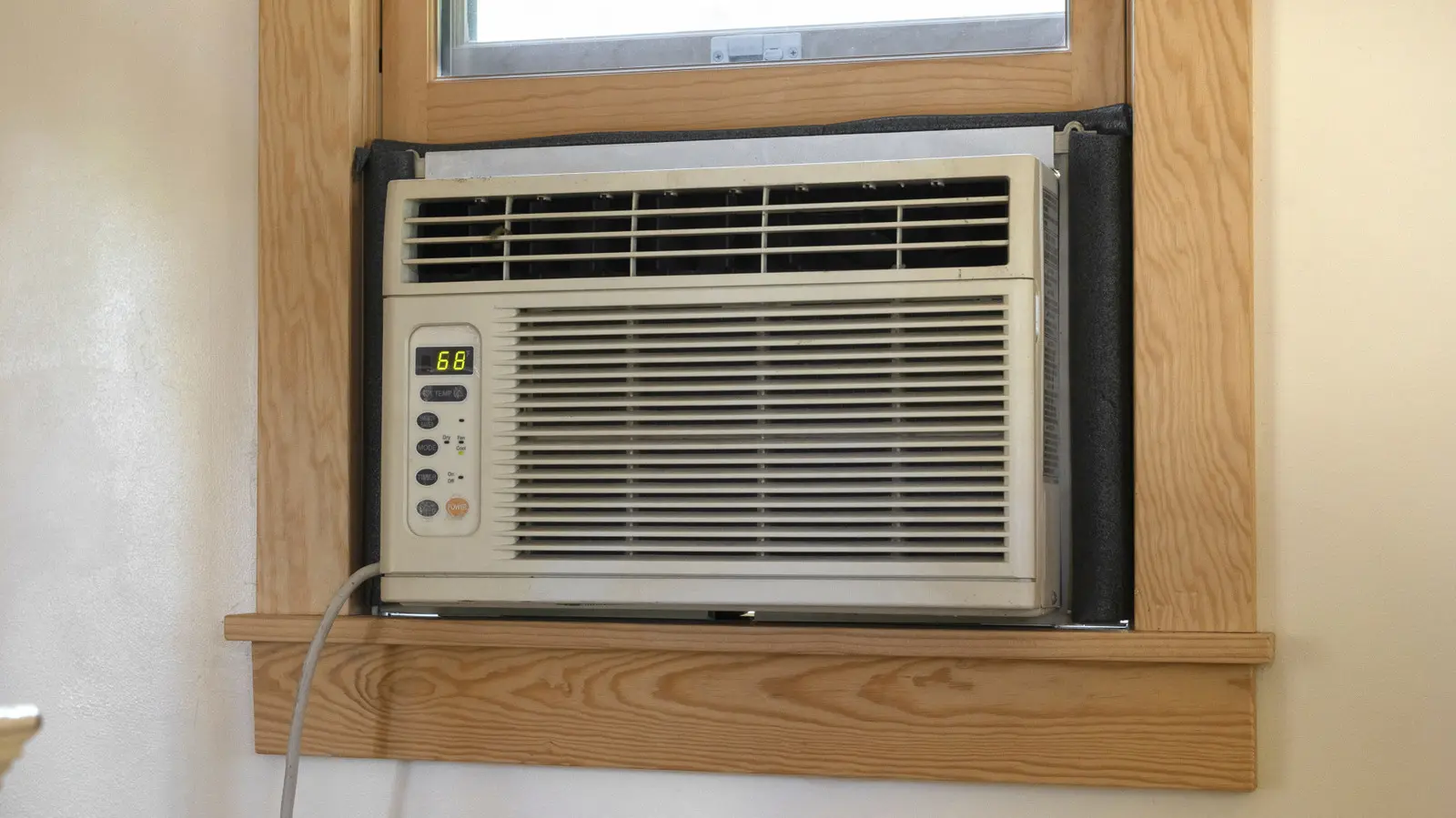
With the summer heat rolling in, finding ways to stay cool is everything. An air conditioner—particularly a unit from one of the most reliable A/C brands out there—can certainly get the job done. With that said, there are some elements of air conditioner shopping that can trip folks up. For instance, it's not uncommon to see a unit's capacity measured in tons, which, fortunately, doesn't refer to the unit's weight. Rather, this dates back to the early days of air conditioning systems, when it was necessary to use full-on blocks of ice to cool indoor spaces.
The Ice Age Origin
Before refrigerant became the norm for air conditioning units, large cooling systems utilized blocks of ice in the late 1800s and early 1900s. These blocks typically weighed around 1 ton, or 2,000 pounds, so it became a standard for air conditioning systems to use tons as a measure of cooling ability. In time, ton became shorthand for the amount of heat required to melt one ton of ice over 24 hours. This heat—known as the latent heat of fusion—is 144 British Thermal Units (BTUs) per pound. So, melting 2,000 pounds of ice requires 288,000 BTUs over 24 hours, or 12,000 BTUs per hour. Thus, one ton of cooling capacity equals 12,000 BTUs per hour. This simple calculation allowed early engineers to design and rate cooling equipment based on a tangible, everyday substance: ice.
The practice of using tons for cooling capacity was formalized by the pioneers of modern air conditioning. In 1902, Willis Carrier invented the first modern air conditioning system, which used mechanical refrigeration instead of ice. However, the ton measurement stuck. Carrier and his contemporaries found it convenient to rate large industrial and commercial systems in tons rather than in the massive BTU numbers that would otherwise be required. Even today, the ton is the standard unit for whole-house and commercial air conditioning systems, while smaller window or portable units are more often rated in BTUs.
Tons vs. BTUs: Understanding the Relationship
As mentioned, one ton of cooling equals 12,000 BTUs per hour. This conversion is crucial when comparing different types of air conditioners. For instance, a window unit might be rated at 8,000 BTUs—equivalent to about 0.67 tons. Conversely, a 5-ton central air conditioner is capable of removing 60,000 BTUs of heat per hour. Using tons simplifies communication for larger capacities, where saying “5 tons” is much more concise than “60,000 BTUs per hour.” However, BTUs remain the more common metric for smaller, room-size units because they allow for finer granularity. Understanding both units helps consumers make informed decisions when shopping for any type of cooling system.
Beyond the conversion, it is important to grasp what BTUs actually measure. A British Thermal Unit is defined as the amount of heat required to raise the temperature of one pound of water by one degree Fahrenheit. In the context of air conditioning, BTU per hour indicates how much heat the unit can remove from a space in one hour. This is directly related to the cooling capacity. A higher BTU rating means more powerful cooling, but it also means the unit will consume more electricity. Therefore, selecting the right capacity is a balance between cooling power and energy efficiency.
The Importance of Proper Air Conditioner Capacity
Choosing the correct capacity for a given space is perhaps the most critical decision when buying an air conditioner. Too low a BTU or ton rating will result in lackluster cooling, no noticeable drop in humidity, and continuous running that can prematurely wear out the system. The compressor and fan run constantly, driving up electricity bills and reducing the unit's lifespan. On the other hand, a too-high BTU air conditioner in a confined space will short-cycle—meaning it turns on and off frequently. This prevents the unit from running long enough to dehumidify the air properly, leaving the room feeling clammy and uncomfortable. Short-cycling also places extra strain on the compressor, leading to early failure. In both cases, the energy wasted is significant, as air conditioners are among the most energy-hungry appliances in any home.
Additionally, correct sizing impacts indoor air quality. Proper dehumidification reduces the risk of mold and mildew growth, which thrive in humid environments. An undersized unit struggles to remove moisture, while an oversized one cools too quickly and shuts off before moisture can be extracted. The result is a space that feels cool but damp, which can promote allergens and bacteria.
How to Determine the Right Capacity
The first step is to calculate the square footage of the area to be cooled. As a rule of thumb, a moderate climate requires about 20 BTUs per square foot. For example, a 500-square-foot room would need approximately 10,000 BTUs (0.83 tons). However, this is a rough guideline. Several factors influence the actual requirement: ceiling height, insulation quality, number and orientation of windows, sun exposure, local climate, and the number of occupants (each person adds about 600 BTUs of heat). Kitchens and rooms with many electronics also have higher heat loads. The professional standard is a Manual J load calculation, which considers all these variables precisely. Online calculators like Calculator.net can provide a good estimate, but for central systems, consulting an HVAC technician is recommended.
In addition to capacity, consider the Seasonal Energy Efficiency Ratio (SEER). SEER measures a unit's cooling output divided by its energy input over a typical cooling season. Higher SEER ratings mean better efficiency, but they also come with higher upfront costs. For most homes, a SEER of 14 to 16 provides a good balance, while premium units can reach 25. Efficiency becomes especially important for larger systems that run many hours per year.
Different Types of Air Conditioners and Their Capacities
Window air conditioners typically range from 5,000 to 15,000 BTUs (0.42 to 1.25 tons). They are ideal for a single room. Through-the-wall units and portable units fall in a similar range. Mini-split ductless systems usually range from 9,000 to 36,000 BTUs (0.75 to 3 tons) per indoor head and are used for one or more zones. Central air conditioning systems for whole homes range from 1.5 to 5 tons, though custom installations can exceed that. Commercial rooftop units often start at 5 tons and can go up to 100 tons or more.
When replacing an existing system, it is not enough to simply match the old unit's tonnage. Changes in insulation, windows, or occupancy may alter the required capacity. A load calculation should always be performed to avoid oversizing or undersizing.
Environmental Considerations and Refrigerants
The type of refrigerant used in air conditioners also affects performance and environmental impact. Older systems often use R-22 (Freon), which is being phased out under the Montreal Protocol due to its ozone-depleting properties. Newer units use R-410A (Puron) or more environmentally friendly alternatives like R-32. When sizing a system, ensure it is compatible with the latest refrigerants, as R-22 is becoming increasingly expensive and difficult to service.
Modern inverter technology allows variable-speed compressors that adjust cooling output to match demand. These systems are more efficient and can dehumidify better than single-stage units. They are often rated in tons as well, but their capacity can vary continuously. When choosing an inverter-based system, the nominal tonnage indicates the maximum capacity, while the minimum capacity might be as low as 25% of that. This flexibility helps avoid short-cycling and improves comfort.
Finally, smart thermostats and zoning systems can further optimize energy usage. By programming temperatures based on occupancy and time of day, homeowners can reduce the load on their air conditioner, potentially allowing for a slightly smaller unit. However, the base capacity should still be chosen based on the peak heat load of the space.
Air conditioners are game-changers during the warmer months, and given how pricey they are, it's crucial to understand what exactly you need. Understanding BTU and ton measurements is an essential step to picking the right air conditioning setup for your space. If you are unsure about the calculations, consulting an HVAC professional who can perform a Manual J load calculation is always a wise investment.
Source:SlashGear News