

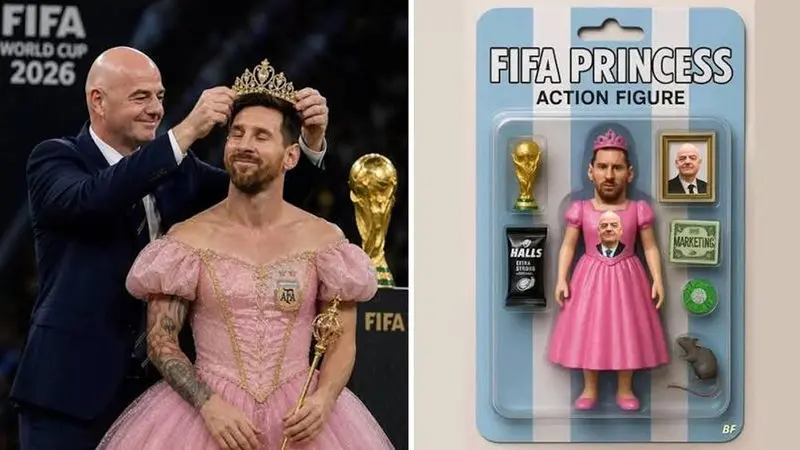
Not all football memes celebrate incredible goals or unforgettable matches. Some are born from fan rivalries, conspiracy theories and years of online arguments. One of the biggest examples from recent years is the nickname "FIFA's Princess," which has become a prevalent way for rival supporters to mock Argentinian soccer superstar Lionel Messi.
Known as the "Lionel Messi FIFA Princess" meme, the joke portrays Messi as FIFA President Gianni Infantino's favorite player, often depicting him wearing pink princess dresses, crowns and tiaras in AI-generated images and edits. So, where did the nickname originally come from, and why did it become so widespread during the 2026 FIFA World Cup? Let's explain.
Origin of the 'FIFA Princess' Meme
The "FIFA's Princess" nickname first emerged during the 2022 FIFA World Cup as rival football fans accused FIFA of favoring Lionel Messi and Argentina throughout the football tournament. Following Argentina's victory in Qatar, conspiracy theories alleging biased refereeing and preferential treatment became increasingly common online as fans expressed their displeasure with the tournament's outcome.
As those claims spread, critics began sarcastically referring to Messi as "FIFA's Princess," suggesting he was receiving special treatment from FIFA and its president, Gianni Infantino. The earliest known uses of the nickname appeared on X / Twitter in December 2022, right around the end of the event, although many of those original posts have since been deleted or lost to time. Among the earliest documented examples was a December 9th, 2022, tweet claiming Messi avoided punishment because he was "FIFA's princess." Similar posts continued appearing throughout 2023 on Facebook, Twitter and other platforms as debates surrounding the 2022 World Cup persisted online.
The meme's origin is deeply rooted in football fandom's culture of suspicion toward governing bodies. FIFA has often been accused of favoritism, especially toward star players who drive commercial value. Messi, as arguably the greatest player of all time, naturally attracts both adoration and envy. The 2022 World Cup final against France saw controversial decisions, including a penalty for Argentina in the first half, which fueled speculation that FIFA wanted a Messi win. While no evidence supports these claims, the narrative was enough to birth the enduring "Princess" meme.
How the Meme Evolved and Spread
The meme initially existed as text posts on social media. By 2023, fans began creating AI-generated images of Messi in princess dresses, often with Infantino kissing his hand or placing a crown on his head. Platforms like TikTok and Instagram saw an explosion of "FIFA Princess" content, with users editing videos of Messi in fairy-tale settings. The meme became a versatile tool for criticism: whenever Messi received a favorable call, fans would flood comment sections with "FIFA's princess" references.
The 2026 FIFA World Cup, held in the United States, Canada, and Mexico, reignited the meme with renewed intensity. Argentina entered as defending champions, and Messi, at 39, was still performing at an elite level. The tournament featured several controversial refereeing decisions involving Argentina, including disputed penalties and VAR reviews. Each decision prompted new waves of "FIFA Princess" posts. The meme also expanded into video edits where AI-generated deepfakes showed Infantino handing Messi a trophy or declaring him "queen of football."
Notably, during the 2026 World Cup, Argentina's matches often sparked debates about referee bias. In the quarterfinal against Switzerland, a handball call that led to an Argentina goal was hotly contested. Critics pointed to Messi's influence, while fans defended the decisions as correct. The meme served as a shorthand for expressing frustration with perceived unfair advantages.
Examples of the Meme in Action
While specific images cannot be displayed here, textual descriptions illustrate the meme's tone. One popular AI-generated image showed Messi wearing a sparkling pink ball gown with a tiara, while Infantino knelt before him holding a golden slipper. Another depicted Messi sitting on a throne made of soccer balls, with Infantino fanning him. Text accompanying such images often read: "When you're FIFA's princess, every call goes your way."
On TikTok, users created skits: a person dressed as Infantino would appear at a match and dramatically hand a whistle to Messi, implying he controlled the referee. Hashtags like FIFAPrincess and MessiPrincess trended during key matches. The meme also crossed into other sports: baseball and basketball fans adapted it for their favorite stars, but the soccer version remained most prominent.
Related Memes and Fan Counter-Memes
The "FIFA Princess" meme belongs to a broader family of online humor targeting star players. It closely relates to "Lionel Messi and Gianni Infantino" memes that depict the two as romantically involved to satirize the perceived favoritism. Both formats became especially popular during the 2026 World Cup, frequently appearing together in edits and fan rivalry posts.
Messi's supporters responded with their own counter-memes. They assigned similar feminine-coded nicknames to Cristiano Ronaldo, calling him "UEFA's Princess" or "Cristiano the Queen." These counter-memes often used parallel imagery, showing Ronaldo in dresses with UEFA officials. The exchange created a cycle of rivalry-driven humor that sustained itself throughout the tournament.
Other related memes include "Consultant Messi" and "Messi helping referee" formats, where Messi is shown whispering in the ear of an official. All these memes share a common theme: questioning the impartiality of football's governing bodies while celebrating or mocking the sport's greatest stars.
Expanding the Context: Messi's Career and FIFA Controversies
To fully understand the meme, one must consider Messi's career trajectory and his relationship with FIFA. Messi won his first World Cup in 2022 after previously falling short in 2014 (final defeat to Germany) and earlier early exits. His 2022 victory was widely seen as the crowning achievement of a career that already included seven Ballon d'Or awards, multiple Champions League titles, and record-breaking goal tallies. However, critics argue that FIFA has a vested interest in promoting Messi as the face of global football, leading to leniency in disciplinary actions or favorable scheduling.
FIFA President Gianni Infantino, who took office in 2016, has publicly praised Messi repeatedly. In 2022, Infantino stated that Messi "deserved" to win the World Cup, a comment that fueled accusations of bias. Furthermore, FIFA's handling of the 2026 World Cup expansion and rule changes has drawn scrutiny. When Argentina faced controversial moments, the meme served as a immediate response.
Messi's on-field behavior also contributed. Known for his calm demeanor, occasional outbursts at referees garnered less punishment compared to other players. For instance, during a 2026 group stage match, Messi appeared to argue vehemently with an official over a foul, yet received no yellow card. Opponents' fans quickly posted "FIFA princess" comments.
The Role of AI in Meme Proliferation
The "FIFA Princess" meme's visual evolution was driven largely by advances in AI image generation. Tools like Midjourney, DALL-E, and Stable Diffusion allowed fans to create high-quality, surreal images that quickly went viral. These AI-generated pictures depicted Messi in increasingly elaborate princess outfits, from Cinderella-style gowns to Disney princess parodies. Some videos used deepfake technology to superimpose Messi's face onto actresses in princess roles, creating humorously cringeworthy content.
AI also enabled the creation of memes that were both targeted and scalable. A single prompt could generate dozens of variations, spreading across social media in minutes. This democratization of meme production meant that even casual fans could participate in the trend, further embedding it in World Cup culture.
Impact on Messi's Legacy and Fan Culture
While the meme is superficially mocking, it reflects deeper tensions in football fandom. Messi's global popularity is immense, but he also has a sizable group of detractors who feel that he receives disproportionate attention and favorable treatment from authorities. The "FIFA Princess" meme gives these detractors a creative outlet to voice their dissent. Meanwhile, Messi's supporters use the meme as a badge of honor, reframing it as a testament to his influence.
The meme also highlights the intersection of football, politics, and technology. During the 2026 World Cup, it was not uncommon to see the "FIFA Princess" hashtag used in political discussions about FIFA's governance, especially regarding the tournament's expansion and human rights issues. This shows how memes can transcend their original context to comment on larger systemic concerns.
Despite the mockery, Messi's performances on the pitch remain extraordinary. During the 2026 World Cup, he broke the all-time goals record, scoring 19 goals across six tournaments. He also became the first man to score in seven consecutive World Cup matches. These achievements, while celebrated by fans, also stoked the "princess" narrative—every record seemed to confirm for conspiracy theorists that FIFA was scripting his success.
Key Facts About the Meme
- Origin: First emerged in December 2022 on Twitter after the Qatar World Cup final.
- Meaning: Sarcastic nickname implying Lionel Messi receives preferential treatment from FIFA President Gianni Infantino.
- Visual Depiction: Messi in pink princess dresses, tiaras, crowns; often with Infantino showing adoration.
- AI Generation: Increased use of AI tools in 2023-2026 to create photorealistic images and videos.
- Resurgence: Became highly popular again during the 2026 World Cup due to controversial refereeing decisions.
- Counter-Memes: Fans of Messi created similar princess nicknames for Cristiano Ronaldo and other rivals.
- Related Memes: Romantic memes between Messi and Infantino; "Consultant Messi" memes.
- Platforms: Spread on Twitter, TikTok, Instagram, Facebook, and Reddit.
- Cultural Impact: Reflects ongoing fan debates about FIFA's impartiality and the mythologization of star players.
As the 2026 World Cup concluded with Argentina reaching the semifinals, the "FIFA Princess" meme remained a persistent part of online football discourse. Its longevity suggests that even after Messi retires, the meme will endure as a symbol of the rivalry between his legions of fans and critics, as well as a commentary on the power dynamics within international soccer governance.
Source:Yahoo Sports News