

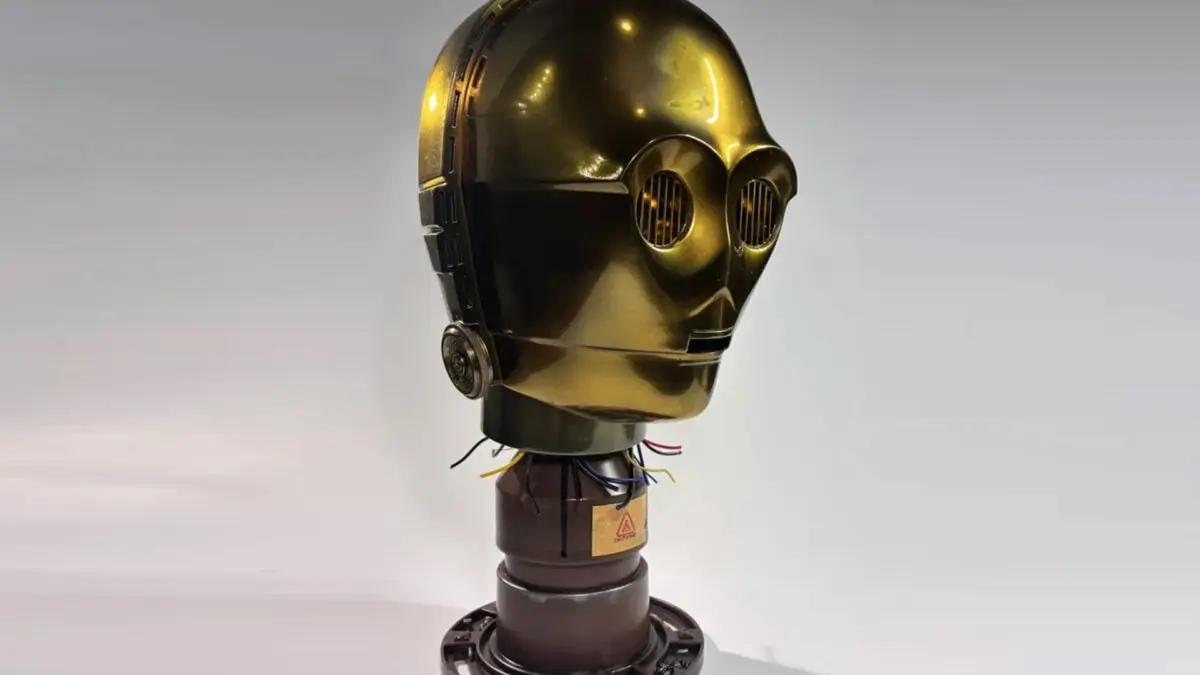
May the fourth be with you, and all that. For Star Wars Day, enthusiasts often celebrate the franchise's most beloved characters, from the stoic Jedi to the gritty rebels. But one character often overlooked is C-3PO, the shiny golden protocol droid whose personality combines the fussiness of a maître d' with the anxiety of someone perpetually walking into a trap. Threepio has been a fixture of the Star Wars universe since the original film, yet he rarely gets the spotlight. That changed recently when a student at Chapman University in Orange County, California, created a DIY talking C-3PO head that uses artificial intelligence to hold conversations. The project, documented on GitHub, offers a fascinating glimpse into how hobbyists can merge 3D printing, electronics, and large language models to bring a fictional character to life.
C-3PO's place in pop culture is unique. While R2-D2 communicates through beeps and whistles, Threepio is verbose, often providing exposition or fretting about the odds of success. His iconic golden exterior and stiff mannerisms make him instantly recognizable. In the Star Wars saga, he serves as a translator and diplomat, which makes him an ideal candidate for a conversational AI project. The original prop head from The Empire Strikes Back fetched over $1 million at auction last month, underscoring the enduring appeal of the droid. But you don't need a million dollars to own a piece of the magic — with some effort and technical know-how, you can build your own version that talks back.
The Origin of the Project
Samuel Potozkin, a student at Chapman University, recently posted a video detailing his journey to create a fully functional C-3PO head. The project combines several technologies: a 3D-printed shell, a Raspberry Pi 5 microcomputer, a microphone, a speaker, and a custom large language model (LLM) trained to mimic Threepio's prissy personality. The goal was to create an interactive display that would respond to spoken questions or comments in real time, using the character's distinctive voice. Potozkin's work is part of a growing trend of AI-infused cosplay and prop building, where enthusiasts push the boundaries of what's possible with off-the-shelf hardware and open-source software.
Technical Pipeline: From Speech to Metal-Cased Response
The core of the system is a straightforward pipeline. When a user speaks into the microphone, the audio is captured by the Raspberry Pi 5, which runs a real-time speech-to-text converter. Once the user's words are transcribed, they are sent as a prompt to the custom LLM. This LLM has been fine-tuned to respond in character, adopting the verbose, slightly condescending tone that defines C-3PO. The model's response is then passed through a text-to-speech engine designed to emulate the character's metallic vocal delivery. The final output plays through a speaker hidden inside the head. This may sound simple in concept, but executing it convincingly required significant tuning.
Achieving the Authentic Voice
One of the biggest challenges Potozkin faced was replicating C-3PO's unique vocal timbre. In a paper published on his GitHub page, he explains that initial tests of the text-to-speech output failed to capture the metallic resonance associated with the character. To solve this, he applied a series of audio post-processing effects that resemble a guitarist's pedalboard setup. A short delay line creates tightly spaced temporal reflections, giving the voice a hollow quality. A chorus effect slightly modulates the time and pitch of duplicated signal paths, which adds the impression of layered vocal resonance. The result is a voice that sounds eerily like the original performance by Anthony Daniels, even when emanating from a disembodied head.
Why This Matters Beyond Star Wars Fandom
While the immediate appeal of this project is to Star Wars fans, it also illustrates how accessible AI technology has become. Just a few years ago, creating a conversational prop of this sophistication would have required expensive custom hardware and a team of engineers. Today, a single hobbyist with a Raspberry Pi and open-source AI models can achieve comparable results. The project also highlights the potential for personalized AI assistants that adopt fictional personas. Imagine a talking Darth Vader helmet that answers questions about the dark side, or an interactive Yoda that dispenses cryptic wisdom. The same technical approach could be applied to any number of characters from movies, TV shows, or books.
Building Your Own: What You Need to Know
For those inspired to attempt their own version, Potozkin's GitHub repository includes detailed instructions, 3D printing files, and code. The Raspberry Pi 5 is the recommended brain, but older models may work with reduced performance. The custom LLM is built on a lightweight framework that can run on the Pi's limited resources, though a cloud-based alternative is also possible for those with an internet connection. The head itself can be 3D printed using a standard filament printer, with the gold finish achieved through spray painting or metallic tape. The entire project cost, excluding a printer, is estimated at under $300.
Cultural Impact and the Future of Interactive Props
As AI continues to evolve, the line between static prop and interactive companion blurs. Props like this C-3PO head could become common in fan conventions, home theaters, and even museums. They offer a new way to engage with beloved characters, turning passive viewing into active conversation. For Star Wars fans, the ability to talk to C-3PO — and hear his irked replies — adds a layer of immersion that was previously impossible. The project also serves as a gateway for young makers to learn about natural language processing, audio engineering, and embedded systems. Potozkin's work is a testament to the power of combining creativity with technology, and it shows that even the most iconic movie props can be reinvented for the 21st century.
So this Star Wars Day, if you're looking for a new project, consider building your own talking C-3PO head. You'll not only impress your friends but also gain a deeper appreciation for what makes Threepio tick. And if you need any help, just remember: he's fluent in over six million forms of communication, but he might still refuse to let you into the fancy restaurant.
Source:Gizmodo News