

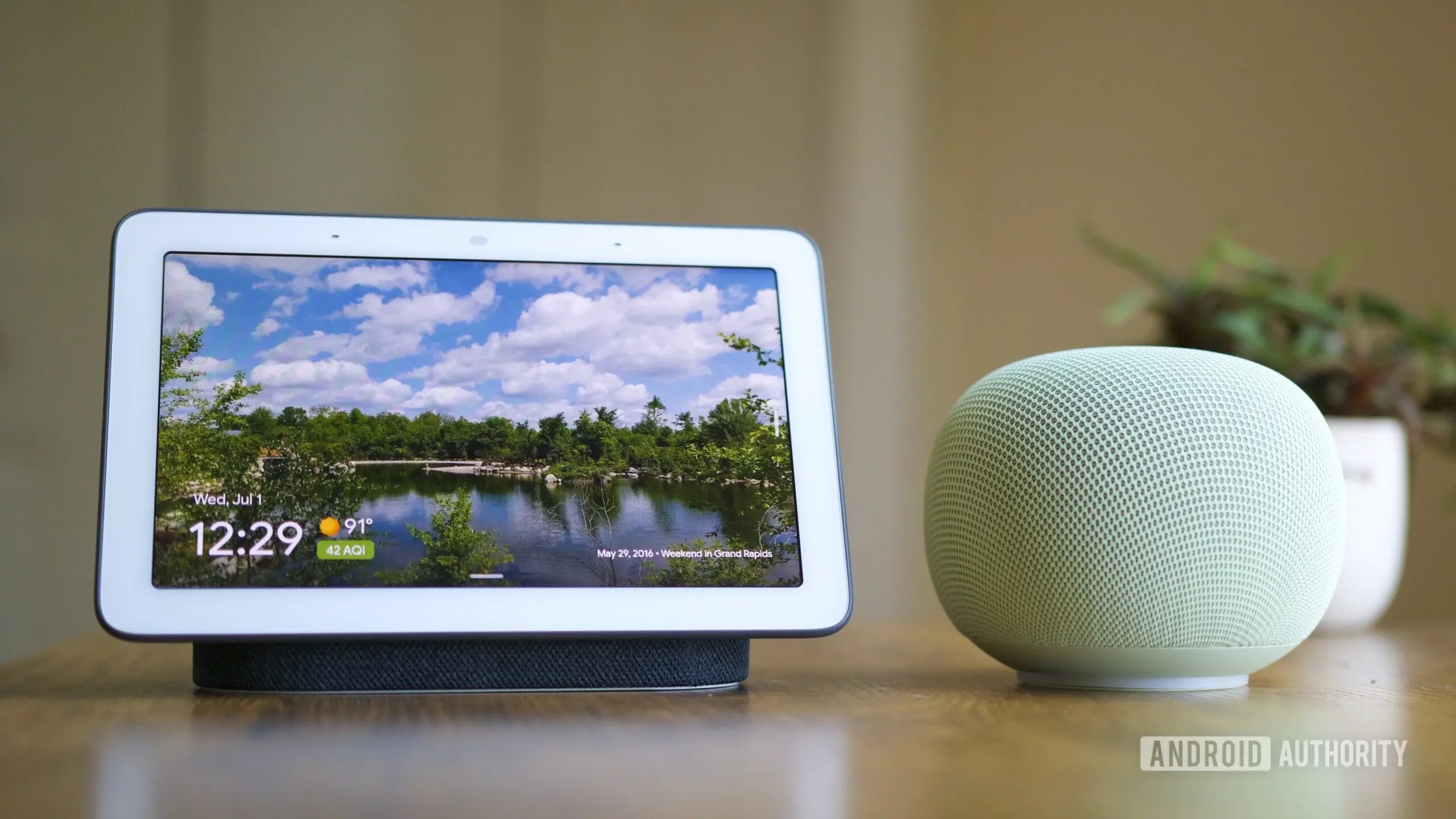
The last few months have been quite notable for Google Home. Late last year, Gemini rolled out to older Google Home speakers, breathing new life into them. Considering the disastrous state the Google Assistant had turned into, this was a huge step forward. But software is only half of the equation. Hardware is equally important, and that’s why the Google Home Speaker is such a big deal. After months of teasing, the Home Speaker finally launched on June 25, making it the first Google smart speaker to hit store shelves in six years.
Just the existence of the Home Speaker is a net positive, as it shows Google hasn’t completely given up on its smart home hardware ambitions. However, the implications it’s already had on Google’s existing smart speakers — and what it represents for Google Home going forward — is extremely troubling. I want to believe in this next chapter of Google Home, but right now, it’s not looking good.
The Home Speaker strategy doesn’t make any sense
The Home Speaker itself is a pretty solid gadget. It’s compact, sounds decent, the colors are gorgeous, and Gemini works very well. If the Home Speaker was slotting itself into the rest of the Google Home lineup as another option for folks to choose from, I’d be a pretty happy camper. Unfortunately, that’s not what Google did. Just days before the Google Home Speaker was released, Google discontinued the Nest Audio and Nest Mini — the only other two smart speakers in the company’s portfolio.
Although the Nest Audio and Nest Mini duo wasn’t perfect — especially compared to the myriad of options in Amazon’s Echo range — it worked. If you wanted a cheap entry point into the Google Home ecosystem, the Nest Mini was essentially perfect. It could fit anywhere, sounded good enough, and the $49 retail price (which was often discounted) made it so you could stick a couple of Nest Minis in your home without breaking the bank. If you wanted something more premium, the Nest Audio was a worthy upgrade. Its two-driver design with a dedicated tweeter and woofer made it a significant improvement over the Nest Mini. And for just $99, it was a good value, too.
But now that the Nest Mini and Nest Audio are gone, the Google Home Speaker is trying to fill both their places — and it’s a worse version of each. As a Nest Mini replacement, the Home Speaker sounds considerably better and is still relatively compact. However, at $99, it completely loses the biggest draw of the Nest Mini: its low price. If you’re building out your smart home — especially if you’re working on a tight budget — there’s a big difference between buying a handful of smart speakers at $49 each versus $99. The Google Home Speaker is trying to replace both the Nest Audio and Mini — and it's a worse version of each.
What’s even more frustrating is that the Home Speaker doesn’t justify its higher price. It shares the same $99 MSRP that the Nest Audio launched with, but where the Nest Audio had a dual-driver design (specifically, a 75mm woofer and a 19mm tweeter), the Home Speaker has just a single 58mm driver. In other words, the $99 Google speaker launching in 2026 sounds notably worse than the $99 Google speaker that launched in 2020. After six years, this is Google’s grand plan — to eliminate its limited (but effective) two-speaker strategy and replace it with a single jack-of-all-trades, master-of-none option. It’s an objectively bad plan, but that’s where we’re at.
What this represents for future Google Home products
All of this puts the Google Home portfolio in an awkward place today, but it also makes me nervous about the implications for future Google Home products. A couple of months ago, evidence of a “Google Home Display” appeared online, suggesting that Google is working on a new smart display to go along with the Home Speaker. As someone with an aging first-gen Nest Hub, I’m all for a modern Google smart display. But given what the Home Speaker did to Google’s speaker lineup, I’m worried Google is planning a similar strategy with the Home Display.
As it stands today, Google’s smart display portfolio includes the Nest Hub, Nest Hub Max, and Pixel Tablet. However, the trio is barely hanging on by a thread. Three of the four available colors for the Nest Hub are sold out on the Google Store, the Nest Hub Max is also only available in a single color, and the Pixel Tablet is completely out of stock. Whenever the Google Home Display rolls around, what do you think is more likely? A) Google replenishing its Nest Hub, Nest Hub Max, and Pixel Tablet stock so we have multiple smart displays to choose from? Or B) Google discontinuing its three current smart display options and going all in on the Home Display as its one and only model? I think the answer is pretty obvious.
I’m not necessarily advocating for Google to prop up its smart home ecosystem on hardware that’s over half a decade old, but ripping away choices and forcing a single model strategy on people isn’t a good call, either. Yet, it’s hard to see anything else happening at this point. The smart display market is competitive, with Amazon offering a range of Echo Shows from 5 to 21 inches, and Facebook’s Portal series also providing options. Google’s single-device approach could backfire if consumers want flexibility in size, price, and features. Moreover, the Pixel Tablet, which functions as a smart display with its Charging Speaker Dock, showed promise for hybrid use. But its discontinuation in many regions suggests Google is consolidating rather than expanding.
Historical context is important here. Google first entered the smart home hardware space with the original Google Home in 2016, followed by the Home Mini in 2017 and Home Max in 2018. The Nest brand acquisition in 2018 led to the Nest Hub and Nest Hub Max, and later the Nest Audio and Nest Mini refined the lineup. For years, Google had a coherent strategy: a small, cheap entry point (Nest Mini at $49), a mid-range option (Nest Audio at $99), and a premium smart display (Nest Hub Max at $229). This allowed users to mix and match based on room size and budget. Now, with the Home Speaker replacing both the Mini and Audio at a single $99 price point, Google is effectively eliminating the budget tier. This could alienate cost-conscious users who might turn to Amazon’s Echo Dot or even third-party assistants like Apple’s HomePod Mini.
Another concern is the software experience. While Gemini integration is a major improvement over the old Assistant, the hardware downgrade may undermine its capabilities. A single driver cannot reproduce the same clarity and bass as a dual-driver system, especially for music playback. Smart speakers are often used for music, so audio quality is a key purchase factor. The Nest Audio was praised for its balanced sound; the Home Speaker, despite being newer, sounds noticeably worse in side-by-side comparisons. This is a step backward, not forward.
Additionally, the lack of a budget option means users may hesitate to expand their smart home ecosystem. I have multiple Nest Minis scattered around my home because they were cheap enough to justify buying three or four. At $99 each, I would think twice before putting a Google speaker in every room. The Home Speaker’s design also lacks the fabric finish that made the Nest Mini blend into any decor; the new model uses a glossy plastic that shows fingerprints and feels less premium.
Looking ahead, the rumored Google Home Display could face similar issues. If it replaces the Nest Hub, Nest Hub Max, and Pixel Tablet, Google will again offer a single screen at a fixed size and price. That might work for some, but smart displays serve different purposes: small screens for nightstands, large screens for kitchens, and portable tablets for travel. Amazon’s Echo Show lineup includes the 5, 8, 10, 15, and 21-inch models, covering almost every use case. Google’s rumored Home Display is expected to be around 10 inches, leaving gaps at both ends. The Pixel Tablet’s portability was a unique selling point; losing that could disappoint users who liked the hybrid tablet/dock experience.
There is also the question of long-term commitment. Google has a history of canceling hardware projects, from the Pixelbook to the Daydream VR headset. The smart home space is already fragmented, with Matter and Thread standards promising interoperability but still maturing. If Google reduces its hardware variety, it risks losing mindshare to competitors. Amazon’s Alexa ecosystem also offers far more third-party devices, and Apple’s HomeKit is gaining traction. Google’s strength has always been its software and integration with services like Google Assistant, YouTube, and Maps. But hardware is the customer touchpoint; without compelling options, even great software can go unused.
Another angle is pricing strategy. The Nest Mini often sold for $29 during promotions, making it an impulse buy. The Home Speaker at $99 rarely sees discounts below $79, which is still double the Mini’s sale price. For a multi-room audio setup, that difference adds up. Users building a whole-home system might now consider alternatives like an Amazon Echo ecosystem or even Sonos speakers with Alexa. Google’s loss of the entry-level speaker could shrink its user base, reducing the attractiveness of its platform for developers and partners.
I want Google Home to succeed. My entire house is centered around Google Home. I have a Nest Hub in my office, a Home Speaker in my bedroom, a Pixel Tablet in my kitchen, a Google TV streaming box in my living room, and a Nest Cam watching my driveway. I want the Google Home ecosystem to be as strong and healthy as can be, because the better Google Home gets, the better my smart home gets. I’m the last person rooting for Google Home to fail, but I don’t see the vision in what Google is doing right now. Taking six years to release an OK smart speaker that’s a worse value than the previous models isn’t a path to success. Likely adopting that same strategy for smart displays won’t help either. Google clearly has a plan in place with the Home Speaker and forthcoming Home Display, and after a multi-year drought of no smart home hardware, I suppose I should be thankful for anything at this point. But try as I might, I just can’t make myself feel that way.
Source:Android Authority News