

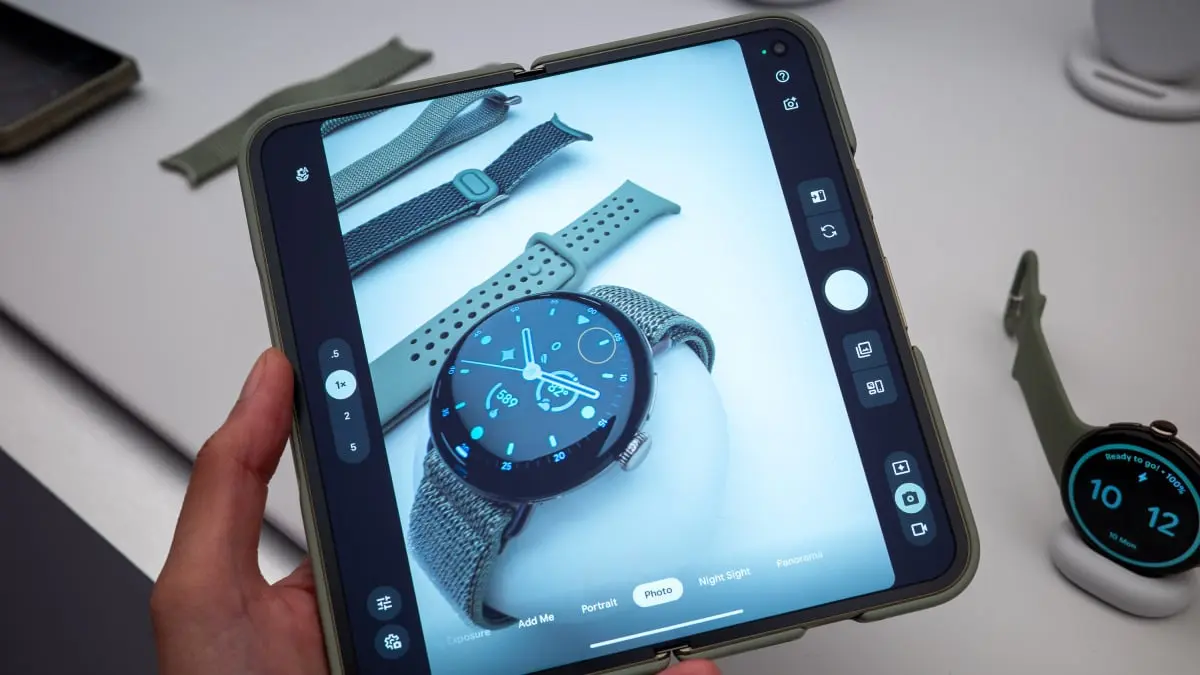
Google has officially announced the Pixel 11 Pro Fold, the latest addition to its foldable lineup and a direct challenger to the Samsung Galaxy Z Fold 8. Positioned as the company's thinnest and brightest foldable yet, the device marks a significant evolution in Google's hardware ambitions, combining a refined design with cutting-edge display technology and the power of the new Tensor G5 chip.
The announcement came during the Made by Google event, where the company also unveiled the Pixel 11 series, Pixel Watch 5, and Pixel Tag. While the non-folding Pixel 11 phones remain the core of the lineup, the Pixel 11 Pro Fold is the device that many enthusiasts were waiting to see. With a slimmer chassis, a dramatically improved display, and new AI-powered features, Google is clearly aiming to capture a larger share of the premium foldable market.
Design: Slimmer than ever
One of the most striking aspects of the Pixel 11 Pro Fold is its physical profile. Google has managed to reduce the thickness significantly compared to the previous Pixel Fold model. At just 9.8mm folded and 4.7mm unfolded, it is not only thinner than its predecessor but also slimmer than most competing foldables, including the Samsung Galaxy Z Fold 8. The weight has also been trimmed to 235 grams, making it feel more like a traditional smartphone and less like a bulky tablet.
The device features an aerospace-grade aluminum frame and a redesigned hinge that allows the two halves of the display to close flat with no visible gap. The hinge mechanism has been tested to withstand over 400,000 folds, according to Google, which should give users confidence in daily durability. The back panel is available in two new finishes: Porcelain and Obsidian, both with a matte texture that resists fingerprints.
Despite the slim profile, the Pixel 11 Pro Fold retains wireless charging, an important feature for a device this thin. Google has also managed to include a larger battery than before, thanks to a new stacked battery cell design that maximizes space efficiency.
Display: A new benchmark for brightness
The Pixel 11 Pro Fold features a 7.9-inch internal foldable OLED display with a refresh rate that dynamically scales from 1Hz to 120Hz. But the headline specification is brightness: Google says the main display can reach a peak brightness of 3000 nits. This is a substantial jump from the previous model's 1750 nits and puts it above the Galaxy Z Fold 8, which peaks at 2600 nits.
For outdoor visibility, this level of brightness is exceptional. Even in direct sunlight, content remains sharp and vibrant. The display also supports full DCI-P3 color gamut and HDR10+, making it ideal for streaming high-quality video or editing photos on the go. The outer cover screen measures 6.4 inches, also with a 120Hz adaptive refresh rate and a peak brightness of 2200 nits.
Google has also improved the anti-reflective coating on the inner display. This is a common pain point on foldable devices, where the plastic layer tends to create glare. The new coating significantly reduces reflections, making the viewing experience more enjoyable in bright environments. Additionally, the screen now includes an under-display camera that is barely noticeable when reading or watching content.
Camera system and AI features
The Pixel 11 Pro Fold continues Google's tradition of computational photography excellence. The camera hardware has been upgraded, but the real magic happens in the software. The primary camera is a 50-megapixel sensor with a larger aperture and improved optical image stabilization. It is paired with a 48-megapixel ultra-wide lens and a 48-megapixel telephoto lens offering 5x optical zoom.
Google has introduced several new AI-powered features specifically for the foldable form factor. One of the most interesting is called "Fold Photography," which utilizes the ability to hold the device at various angles. For example, the phone can act like a tripod when half-folded, allowing for multi-exposure night shots or time-lapse videos without additional accessories. The cover screen can also function as a preview display, letting the subject see themselves before the shot is taken.
Another new feature is "Magic Eraser Plus," an evolution of the previous Magic Eraser tool. It uses on-device machine learning to remove unwanted objects or people from photos with even better accuracy, reconstructing the background seamlessly. The Pixel 11 Pro Fold also benefits from Video Boost, which enhances video quality by processing frames in HDR and improving stabilization, even in low-light conditions.
Google Lens integration is deeper than ever. You can point the camera at a document, a menu, or a landmark, and the phone will provide contextual information or translations in real time. This works particularly well on the large inner display, where you can see the original image and the overlaid text simultaneously.
Performance and battery
Under the hood, the Pixel 11 Pro Fold is powered by the Tensor G5 chip, which Google developed in close partnership with TSMC. The new chip is fabricated on a 4nm process, delivering a 25% improvement in CPU performance and a 40% boost in GPU performance compared to the previous generation. This makes the foldable more than capable of handling demanding tasks such as 4K video editing, gaming, and multitasking with multiple apps open side by side.
The Tensor G5 also enhances on-device AI processing, enabling many of the new camera and assistant features to work without an internet connection. Google Assistant can now operate with lower latency, and the company's language model can run efficiently on the device, providing better contextual understanding for voice commands.
Battery capacity has been increased to 5,000mAh, which is impressive for a foldable device. In practical terms, users should comfortably get through a full day of heavy use. The phone supports 37W wired charging, 23W wireless charging, and 5W reverse wireless charging. While these speeds are not the fastest on the market, they are an improvement over the previous Pixel Fold and are sufficient for most users.
Software and multitasking
The Pixel 11 Pro Fold runs Android 16 out of the box, with Google's newest feature set for foldable devices. The operating system has been optimized to take advantage of the large inner screen. For example, users can now drag and drop apps to create custom split-screen pairs that launch simultaneously. A new taskbar appears when you swipe down from the top of the screen, allowing quick access to frequently used apps.
Google has also improved app continuity. If you are using an app on the cover screen and you unfold the device, the app will seamlessly transition to the larger display, often expanding to show more content. This works smoothly for most installed apps, and Google has been working with third-party developers to ensure compatibility.
One of the unique features of this foldable is "Live Display," which uses the cover screen to show a clock, calendar, and notifications when the phone is closed. The display can be left on with an extremely low refresh rate, preserving battery life. When you open the phone, the content shifts to the main screen without interruption.
Availability and pricing
The Pixel 11 Pro Fold is available for preorder starting August 12, 2026, with shipping expected later in the month. The price starts at $1,799 for the 256GB model and $1,999 for the 512GB model. Preorders include a free $350 gift card from select retailers, making the effective price more attractive for early adopters.
Carrier availability includes all major US networks, and Google is offering a trade-in program that can reduce the price by up to $800, depending on the device you send in. International availability will vary by region, but Google has confirmed that the device will launch in the same markets as the previous Pixel Fold.
Comparing with the competition
The foldable market has grown increasingly competitive, with Samsung, Motorola, OnePlus, and even Apple rumored to be working on foldable designs. The Samsung Galaxy Z Fold 8 is the most direct competitor. It offers a similar size, a robust camera system, and Samsung's S Pen support. However, the Pixel 11 Pro Fold has advantages in terms of brightness, software experience, and AI features.
Apple has not yet released a foldable phone, but reports suggest it could arrive in the coming years. The Pixel 11 Pro Fold gives Google a chance to establish itself as the preferred choice for users who want a seamless Android experience with cutting-edge hardware. The integration between the Tensor chip and Android software is unmatched, making the device feel fluid and intuitive in everyday use.
Motorola's Razr Plus offers a more compact design, but it lacks the large internal screen that allows for productivity tasks. OnePlus, meanwhile, has been aggressive on pricing, but the Pixel's camera and AI capabilities give it a distinct edge for photography enthusiasts.
Overall, the Pixel 11 Pro Fold represents a major leap forward for Google's foldable lineup. Its slim design, record-breaking display brightness, and powerful AI features make it one of the most compelling foldable phones on the market today.
Source:Mashable News