

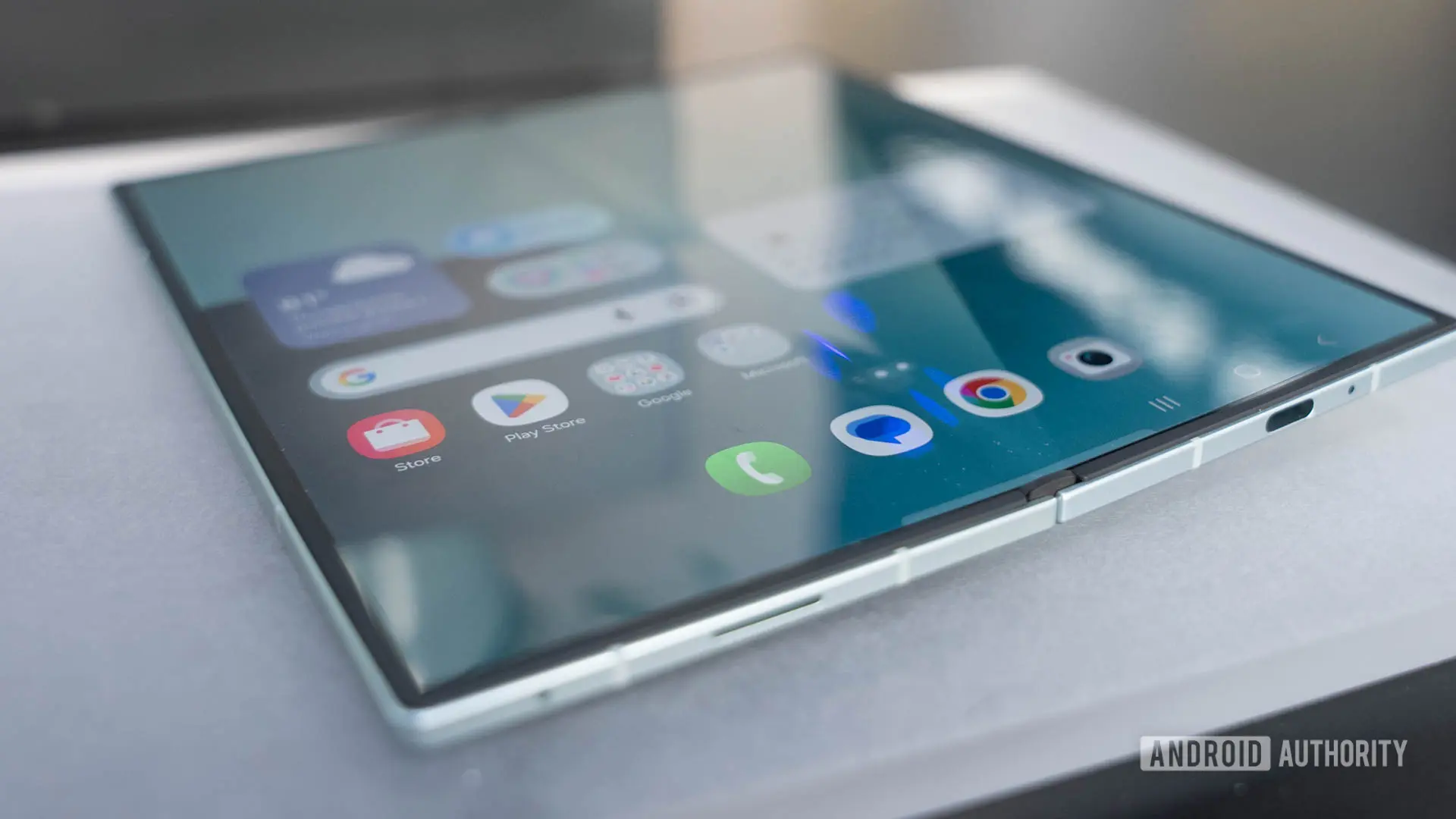
Foldable smartphones have evolved rapidly over the past few years, with manufacturers competing to eliminate the long-notorious display crease that has plagued the form factor since its inception. While early foldable devices from Samsung, Huawei, and others featured pronounced creases that were both visually and tactilely noticeable, recent iterations have made significant strides toward flattening the display. Now, a fresh leak indicates that Samsung’s upcoming Galaxy Z Fold 8 series may achieve a level of crease performance that rivals—and possibly surpasses—the best in the industry.
Hinge Redesign Promises Near-Invisible Crease
According to tipster Ice Universe, who has a track record of accurate Samsung predictions, the Galaxy Z Fold 8 and Galaxy Z Fold 8 Ultra will feature a redesigned hinge mechanism that dramatically reduces the visibility of the crease. The leaker claims that the crease on these upcoming devices will be comparable to that seen on OPPO’s Find N6, a device widely praised for its nearly invisible crease. This is a significant leap from the Galaxy Z Fold 7, which, while improved over earlier models, still retained a noticeable crease under certain lighting conditions.
The hinge redesign is said to involve engineering changes to how the folding mechanism operates. The leaker notes that the new hinge makes the opening and closing action feel more deliberate, potentially offering a more premium haptic experience. However, an intriguing trade-off is that the foldables may no longer stay propped open at certain angles as easily as previous Galaxy Z Fold models. This could impact Samsung’s signature “Flex Mode,” which allows the device to stand partially open for hands-free photography, video calls, or media consumption.
A Closer Look at Flex Mode Implications
Flex Mode has been a defining feature of Samsung’s foldable lineup, enabling users to fold the device to a specific angle—typically between 75 and 115 degrees—and have the UI adapt accordingly. For instance, the camera app splits the screen into a viewfinder on top and controls on the bottom, while video apps like YouTube move the player to the upper half and present comments below. If the new hinge no longer holds at intermediate angles as firmly, users may find it trickier to maintain that ideal 90-degree position. Samsung could address this through software adjustments, but the hardware limitation could frustrate power users who rely on Flex Mode for productivity.
This potential shift suggests that Samsung prioritized crease reduction over hinge stiffness, a trade-off that may be acceptable to most buyers who consider the crease a bigger aesthetic flaw. However, the company has historically emphasized both durability and versatility, so the final product may strike a balance that preserves Flex Mode functionality.
Competitive Landscape: OPPO’s Lead and Samsung’s Catch-Up
The foldable display crease has been a persistent challenge for all manufacturers, but OPPO has emerged as a leader in minimizing its visibility. The OPPO Find N6, launched in early 2025, uses a waterdrop-shaped hinge that allows the display to fold with a larger radius, thereby reducing stress and crease depth. Other Chinese brands like Xiaomi and vivo have also adopted similar designs, while Samsung has traditionally used a gear-based hinge that, while durable, left a more noticeable crease.
If Samsung manages to match OPPO’s crease performance, it would remove one of the few remaining advantages competitors held over the Galaxy Z Fold series. Samsung’s foldables already lead in software optimization (with features like DeX, Multi-Window, and One UI’s foldable adaptations), durability (with IP48 water resistance), and global availability. A near-invisible crease would further solidify Samsung’s position as the default choice for foldable smartphone buyers.
What We Know About the Galaxy Z Fold 8 Series
The Galaxy Z Fold 8 and Fold 8 Ultra are expected to debut in late July or early August 2025, following Samsung’s typical Unpacked event schedule. The standard Fold 8 is rumored to adopt a wider aspect ratio when unfolded, similar to the Galaxy Z Fold 4 era, making it more squared-off and arguably more useful for multitasking. The Fold 8 Ultra, meanwhile, is expected to feature a larger display and possibly a built-in S Pen silo, though details remain scarce.
Both models are likely to use Samsung’s next-generation OLED panels with reduced reflectivity and enhanced brightness, building on the 2,600-nit peak of the Fold 7. The under-display camera (UDC) might also see improvements, as the tiny region of less dense pixels still compromises image quality on current foldables. Battery capacity and charging speeds are expected to receive modest upgrades, though Samsung has been conservative in this area compared to Chinese competitors.
In terms of pricing, the Fold 8 may retain the $1,799 starting price of its predecessor, while the Ultra could command a premium of $100 to $200. Carriers and Samsung’s trade-in promotions will likely soften the blow for upgraders.
Ice Universe’s Track Record and Credibility
Ice Universe (an anonymous Weibo-based leaker) has a mixed but generally solid history of Samsung leaks. They accurately predicted the Galaxy Z Fold 3’s S Pen support, the Galaxy S23 Ultra’s 200-megapixel camera, and several display specifications. However, they have also missed or overestimated some features, such as the exact camera hardware for the S24 series. Therefore, while this crease reduction claim is plausible and aligns with industry trends, it should still be treated with caution until Samsung or reliable supply chain sources confirm it.
The leaker specifically states that the crease improvement applies to both the Fold 8 and Fold 8 Ultra, meaning Samsung is not limiting the better hinge to a single model. This consistency is good news for consumers, as some earlier rumors had suggested only the Ultra would get the premium hinge. Instead, both devices appear to share similar underlying hardware for the folding mechanism.
Historical Context: The Evolution of Samsung’s Crease Reduction
Samsung’s first-generation Galaxy Fold (2019) had a prominent crease that often required manual pressing to flatten. The Galaxy Z Fold 2 introduced a reinforced display and a more refined hinge, but the crease remained visible. With the Z Fold 3, Samsung added IPX8 water resistance and an under-display camera while slightly reducing the crease depth. The Z Fold 4 made further improvements by using a new composite material for the hinge that allowed tighter folding. The Galaxy Z Fold 5 adopted a waterdrop hinge for the first time, resulting in a less pronounced crease, but it was still noticeable compared to OPPO’s offerings. The Z Fold 6 continued refining the hinge but didn't achieve parity with the best Chinese foldables.
The Galaxy Z Fold 7, launched in late 2024, was touted as having a “significantly reduced” crease, but independent reviews still found it deeper than that of the OPPO Find N5 or Xiaomi Mix Fold 4. Now, with the Fold 8 series, Samsung seems determined to close that gap entirely.
Technical Challenges and Engineering Solutions
Eliminating the crease completely involves a careful balancing act of hinge design, display flexibility, and screen protector integration. The display in a foldable must withstand daily folding cycles—typically rated for 200,000 folds—without cracking or delaminating. A shallower crease often requires a larger folding radius, which in turn demands a thicker hinge assembly and compromises the ability to stay open at custom angles. If Ice Universe’s claim about reduced mid-angle stability is accurate, it implies Samsung has chosen a hinge geometry that prioritizes a flat surface over multi-angle flexibility.
Another factor is the screen protector: Samsung’s foldables come with a pre-installed protective film that can also exacerbate the crease if not properly matched to the panel. Newer materials like “Ultra Thin Glass” (UTG) with improved flexibility may allow a tighter radius without cracking, but the protector still introduces a boundary. OPPO’s approach uses a proprietary flexible glass combined with a very thin PET film that distorts less. Samsung may have adopted similar materials for the Fold 8 series.
What This Means for Consumers and the Foldable Market
If the leak proves true, the Galaxy Z Fold 8 and Fold 8 Ultra will remove a significant psychological barrier for potential foldable buyers who are still put off by the crease. The crease not only affects aesthetics but also can interfere with touch sensitivity and stylus usage (for the S Pen). A near-invisible crease would make the foldable experience much closer to a regular slab phone, accelerating mainstream adoption.
Competitors like OPPO, vivo, and Xiaomi will need to find other ways to differentiate—perhaps through faster charging, better cameras, or lower prices. But Samsung’s ecosystem advantages (Wear OS watches, Galaxy Buds, SmartThings, DeX) and global carrier support give it a strong foothold. The foldable market is expected to grow 40% year-over-year in 2025, and a more refined Galaxy Z Fold 8 could capture a larger share of that growth. The crease reduction may ultimately be the tipping point that convinces fence-sitters to take the plunge.
Source:Android Authority News