

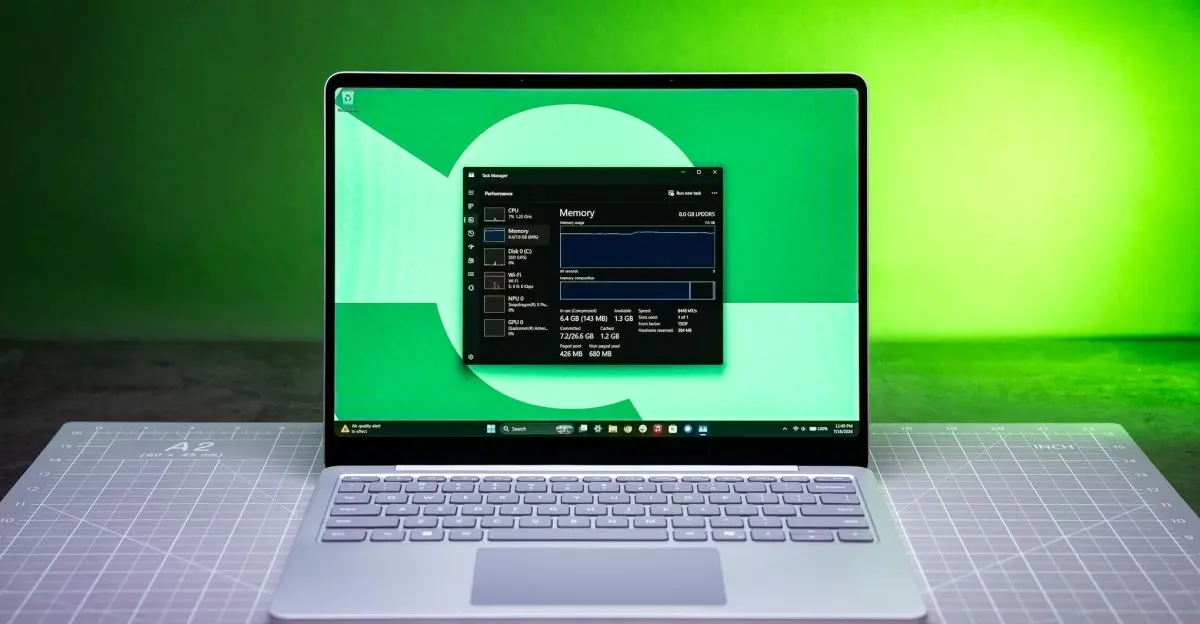
Last year, Microsoft's 13-inch Surface Laptop was widely praised as one of the best thin-and-light Windows notebooks, offering MacBook Air-like build quality, excellent battery life, and a competitive price. At $900, it was an easy recommendation for anyone seeking a premium Windows experience without the Apple premium. Fast forward one year, and the story has changed dramatically. Thanks to a global RAM shortage driven by AI server demand and memory manufacturer consolidation, that same laptop now costs $950 — a $50 increase — but comes with only 8GB of RAM, half of last year's 16GB standard. The external hardware is identical, but the internal experience has been severely compromised.
The RAM shortage, often dubbed "RAMageddon," has its roots in a combination of factors. Memory makers like Samsung, SK Hynix, and Micron have shifted production capacity toward high-margin HBM (High Bandwidth Memory) used in AI accelerators, leaving less supply for traditional DRAM. This has driven up prices for LPDDR5X and DDR5 RAM, forcing PC manufacturers to economize by reducing memory in entry-level models. Microsoft is not alone in this; Dell, Acer, Asus, and others have announced upcoming laptops with 8GB of RAM as the base configuration. However, Microsoft's decision to launch its flagship Surface line with such a limitation is particularly ironic, given that it is one of the largest consumers of HBM for its Azure AI infrastructure.
Testing the 8GB Surface Laptop reveals a frustrating experience. The Qualcomm Snapdragon X Plus processor (X1P-46-100) is competent on its own, but with only 7.6GB of usable RAM (after system reservation), Windows 11 itself consumes around 4.2GB after a fresh boot. That leaves roughly 3.4GB for everything else — applications, browser tabs, background processes, and any multitasking. In practice, this means the laptop often runs at 85-90% memory utilization even during light use. Opening just six Chrome tabs with a couple of extensions, along with Slack and Signal, pushes usage past 6.7GB, leaving virtually no headroom.
During a Microsoft Teams call — using the desktop app, not the browser — the host played a short video, causing the entire system to freeze for several seconds. This happened multiple times throughout the test period, even when no video streaming was involved. Temporary freezes also occurred while working in Google Docs, with no other demanding applications running. Such behavior is unacceptable for a $950 device in 2026. The reviewer noted that these hangs were random and frequent enough to undermine confidence in the machine's reliability.
Modern operating systems and applications have grown increasingly memory-hungry. Windows 11's minimum system requirements officially list 4GB of RAM, but that is barely enough to run the OS without any third-party software. Real-world usage demands much more. Web browsers like Chrome and Edge aggressively use RAM for tabs, extensions, and background processes. Communication apps like Teams and Slack consume hundreds of megabytes each. Even something as simple as a PDF reader or a music streaming service adds to the memory footprint. The 8GB configuration leaves no room for future software updates, which typically increase resource requirements over time.
Compared to the MacBook Neo, which also ships with 8GB of RAM, the Surface Laptop fares worse. macOS appears to handle memory pressure more gracefully, with more aggressive compression and swapping. In side-by-side testing, the Neo could sustain more simultaneous tasks without freezing, despite having the same amount of physical memory. The Neo also costs $699, $250 less than the Surface Laptop, and offers better performance for typical productivity workflows. However, the Neo also suffers from a shorter shelf life compared to higher-end MacBook Air models, as its 8GB will become a bottleneck sooner.
Benchmark results illustrate the performance gap. In Geekbench 6 CPU multi-core, the 8GB Surface Laptop scored 9,421, while the 16GB 2025 model scored 11,428 — a 18% improvement. The difference is even more stark in GPU benchmarks: the 8GB model managed 9,554 in Geekbench 6 OpenCL, while the 16GB version reached 18,391, almost double. Photoshop performance was also severely impacted, with the 8GB model scoring 2,887 in PugetBench versus 4,773 for the 16GB model. These results show that memory capacity directly affects computational throughput, especially in graphics and content creation tasks.
The storage situation adds to the problem. The base model comes with 256GB UFS 2.2 storage, which is slower than the NVMe SSDs found in most competitors. Sustained read speeds are around 3,800 MB/s, which is adequate, but write speeds drop to about 3,300 MB/s. When RAM is insufficient, the OS relies more on virtual memory (pagefile), and a slower storage subsystem exacerbates performance issues. The 512GB version of the 2025 model used NVMe and showed faster write speeds. With only 256GB, users will also face space constraints, as Windows 11 and common applications can quickly consume over 100GB.
Microsoft has publicly stated that it is focusing on improving Windows 11's performance and reliability for lower-cost hardware, partly in response to competition from Chromebooks and low-cost ARM devices. However, the 8GB Surface Laptop suggests that these efforts are not yet sufficient. The OS itself is a major contributor to memory pressure, with numerous background services, widgets, and telemetry features running by default. While some of these can be disabled, most users will not perform such optimizations. The bloat is a persistent complaint among Windows users, and Microsoft seems unwilling to slim down the OS dramatically.
The broader implications for the PC industry are concerning. With the RAM shortage expected to last at least until 2027, more manufacturers will likely adopt 8GB as the standard entry-point configuration. Consumers on a budget will face a choice: either pay a premium for 16GB models, which could cost $150-300 more than the base, or accept a compromised experience. Refurbished and open-box units from reputable sources might be a better value, as they often include 16GB RAM at lower prices. Alternatively, some may opt for macOS devices like the MacBook Air (now starting at 16GB for $1,099) or the cheaper MacBook Neo.
The Surface Laptop itself remains a well-built machine with a comfortable keyboard, a responsive trackpad, a sharp 1080p webcam, and excellent battery life that easily exceeds 10 hours. The 13-inch touchscreen display, while limited to 60Hz, is bright and color-accurate. Port selection includes two USB-C 3.2, one USB-A 3.1, and a headphone jack, which is adequate for most users. The device weighs just 2.7 pounds, making it highly portable. However, these positives are overshadowed by the RAM bottleneck, which makes the laptop feel sluggish and unreliable for any task beyond basic web browsing or video streaming.
Microsoft's pricing strategy also raises eyebrows. The 8GB model costs $950, while the 16GB variant is $1,150 — a $200 premium. That is a steep price for doubling memory, especially when the RAM itself costs the manufacturer only around $20-30. The markup reflects both the shortage and Microsoft's desire to maintain profit margins. As prices continue to rise, the same $950 8GB laptop could become $1,050 next year, making it even harder for budget-conscious consumers to find a decent Windows machine.
For those who must stay on Windows, the recommendation is clear: avoid any new laptop with 8GB of RAM, regardless of brand. Look for models with at least 16GB, even if that means stretching the budget or considering older refurbished units. The Surface Laptop in its 8GB configuration is a cautionary tale of how hardware limitations can undermine an otherwise excellent product. As the industry grapples with the RAMageddon, consumers will need to be more vigilant than ever about memory specifications.
Source:The Verge News